Tuesday, February 1, 2011

Oncidium

 
Fig. 1    Oncidium (Colmanara Wildcat 'Bobcat')


 A friend of mine gave me an Oncidium orchid last Christmas. Although there are hundreds of species and hybrids under this category of orchids, the one I got is called Colmanara Wildcat 'Bobcat'. The plant came already blooming and more than a month later today, the flowers are still there. The glossy burgundy petals edged around the far end with a touch of gold (Fig. 1) continue to provide a colorful crown to the green leaves. This orchid is commonly seen in many stores in the country but I will introduce it here by featuring some of its attributes that are not so obvious to the eye.

Fig. 2    Oncidiums have column wings

Distinguishing Characteristics. Oncidium is a genus in the orchidaceae family. It is known to be a native of the South America and the Caribbean. It was a Swedish botanist and taxonomist, Olof Peter Swartz [1] who brought this genus to the attention of world. There are hundreds of species and hybrids that are now classified as Oncidium. Nowadays, we would know that an orchid is an Oncidium by the following characteristics:

1. They have column wings
2. The presence of a callus or a tissue growth on the interior side of the lip
3. The formation of pseudobulbs with 1-3 leaves
4. The growth of bracts at the base of pseudobulbs

Hybridization material. Oncidium is one of the most widely utilized orchids for hybridization.  Hybridization is the process of combining desirable characteristics from two genetically different plants into one offspring-plant by way of cross pollination. For example, plant A may have beautiful flowers but blooms only once a year. On the other hand, Plant B may not be so beautiful but it blooms repeatedly during the year. Plant A and Plant B would then be crossed (through hybridization) to combine their desirable attributes (beauty and multiple blooming times) into one plant. That is hybridization in simple terms - but to come up with the ideal hybrid is a long process. Offspring from the same parents exhibit genetic diversity. Out of hundreds or thousands of seeds that result from one cross (Plant A x Plant B) it would be very fortunate to find just the right plant immediately. There are undesirable characteristics of each parent that get transmitted to the offspring, of course. Breeding is long process of cross pollination (of ideal parents) and selection (from resulting offspring) but when the right combination is reached, the reward is worth all the time and effort. Hybridization is achieved by controlled pollination. Most hybrids are interspecific (cross between two species from the same genus) or intervarietal (cross between two varieties/hybrids of the same species which may have resulted from earlier a crosses). In the case of the Colmanara Wildcat 'Bobcat', the plant is the offspring of two other hybrids of different genera (singular -genus): Odontonia (Miltonia x Odontoglossum) and Odontocidium (Oncidium x Odontoglossum). This makes the Colmanara Wildcat an intergeneric hybrid.

Intergeneric hybrid is an uncommon type because it is developed by crossing two plants of different genera. To explain this let me use the example of a more common genus - Solanum. Solanum is a group of plants that are considered nightshade. Among the plants under this genus are tomatoes, eggplant, potatoes, etc. Intergeneric hybridization would involve crossing two different plants from this genus; eggplant x tomato or tomato x potato; it does not happen easily.  So you get the idea; intergeneric hybridization is a challenging process.  On the contrary, it is a common knowledge that interspecific hybridization is the easiest way to find compatibility in parent materials. Going back to orchids, the fact that intergeneric hybridization is possible or even common could reflect some degree of error in classification systems rather than a successful betrayal of genetic boundaries.  It is for that reason that there is a wide variety of Oncidium intergeneric hybrids [2] in the market today.

 
Fig. 3    Callous on labellum and winged-column

Pseudoantagonism.  Most pollinators visit a flower in search of something that they desire such as food or even a mate. Plants on the other hand are often designed to attract their pollinators using scent, color and sometimes reward them with nectar. Some plants do not have anything to offer - so they rely on deceiving the pollinators; this is called deceptive pollination. Oncidium attracts its natural pollinator, the Centris bee, by simulating the apprearance of an enemy-insect. Natural pollination happens by way of pseudoantagonism. In this case the pollinator-bee is deceived into thinking that the flower (because of its shape) is a threat; it attacks the enemy in an attempt to defend its territory. When the bee strikes the enemy a.k.a. flower, the pollinia erupts and the pollens adhere to the attacker. The pollens get carried to the next flower during the next attack. If you use your imagination you can also recognize this insect-like structure on the column which is the center of the flower (Fig. 3). This is a unique and weird pollination mechanism but this is just one of the wonderful mysteries of plant life. 

 
Fig. 4   Pseudobulb with one to three leaves

The bracts that originate from the basal sides of the pseudobulbs are the ones that bear the spikes.
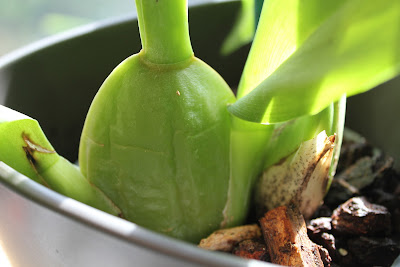
Fig. 5     Bracts growing at the base of pseudobulb.

The next time you go to the store,  try to see if you can identify the Oncidium from the rest of the orchids. 

References:

Sunday, January 16, 2011

Time to Rest

 
 White-crowned Sparrow (Zonotrichia leucophrys) on boxwood hedge.

'A garden must combine the poetic and the mysterious with a feeling of serenity and joy.'
~ Luis Barragan

Suitable or Questionable?

Wooly Rose (Echeveria cristata 'Doris Taylor') cannot withstand freezing temperatures.

Questionable Plant.  Some of my frost-sensitive plants get special treatment these days by being placed close to the house to take advantage of the heat from the walls.  They are also moved around where they can be in the sun even for just a few minutes of the day.  Frost damage can be avoided or reduced when the plants get a chance to recover by getting exposed to warmer temperatures early the next day.   This wooly rose (Echeveria cristata) cannot withstand freezing temperatures - a lesson I learned last year.  Fortunately, it survived and that is why it is still here - but it is now under observation.  Plants that die in my garden because they require too much care do not deserve to be here.  

Suitable plants are beautiful.

Suitable Plant.  If a plant proves to be suitable under our climatic conditions and if they prove to be beautiful and requiring minimal maintenance, then it deserves consideration.  It is guaranteed that it will be provided with the chance to proliferate.  

Suitable plants are adaptable.

Sometimes we fall in love with a particular plant that we ignore the amount of effort that we put into its maintenance.  As gardeners we all need to train our heart and mind to agree. 

Thursday, January 13, 2011

One Reason Not to Over Water Succulents

Echeveria spp.
The leaves crack.  Too much water in the plant tissues result in increased turgor pressure; eventually the pressure breaks the cell wall.  Normally, transpiration (loss of water through the leaves) alleviates the pressure coming from the contents of the cells.  The leaves of most succulents, however, are designed to hold water. Transpiration, which is a constant event in most plants, balances the water level in the cells.  In the case of succulents this process is set to very low level or even none at all. Sometimes they have leathery or waxy leaves from a thick layer of epidermis that keep the water inside.  This is how they adapt to dry environments.  However, when they are exposed to conditions of excessive water their defensive virtues work against them. 

Not all succulents respond to excess water in the same way.  Some of them rot starting from the parts that are directly in contact with the excess moisture. 

Tuesday, January 11, 2011

Arizona

Saguaro (Carnegiea gigantea) plant against the sunsetPhoto from Wikipedia

In the wake of the tragedy that has beset Arizona last Saturday, I present to you the state flower of the Grand Canyon State - the Saguaro (Carnegiea gigantea)!

Saguaro (Carnegiea gigantea) flowers.   Photo from Wikipedia


Saguaro (Carnegiea gigantea) in bloom. Photo from Wikipedia


Because we care...

Learn about this plant: 

Wednesday, January 5, 2011

My Winter Herbs

Rosemary (Rosmarinus officinalis)

While basil, cilantro (annual), garlic chives, sage, and oregano (perennial) have surrendered to the effects of winter, some of them are still growing and providing us with the needed aromatics for the season.   

Rosemary (Rosmarinus officinalis) is growing beautifully - it is hardy in temperatures that are way below temperatures in our area.     My rosemary plans are planted in pots.  Every year I transfer them to a bigger pot allowing them to get bigger.   When trimmed properly they make great topiaries and landscape plants.   The good thing about rosemary is that it is very easy to propagate.  Early in the fall, my fifteen-year-old son cut some branches and propagated them.  With his "high-neglect" technology he was still able to get a good survival rate.

   
Surviving rosemary cutttings.

The scientific name Rosmarinus comes from the Latin words: ros meaning dew and marinus meaning sea.  In other words dew of the sea.  Rosemary, a Mediterranean plant, is drought tolerant.  It is believed that the dew of the sea is enough to supply its water requirement.  The word officinalis indicates that it is a plant with a medicinal value.

Peppermint (Mentha piperata)

These mint hills are planted in hollow blocks that I used as border for my vegetable plots.  It turned out to be a great container for this ever-spreading plant.   They were planted last spring and have been trimmed twice - once in the summer and once in late fall.  Regular cutting-back prevents the stems from touching the ground - which is to be avoided at all times.  Mint is roots so easily and sends out stolons that spread underground.  Stolons are modified stems that grow underground.  They emerge out of the ground, to function and become regular stems.  By the time the stolons appear above-ground it's usually be too late.  An invasive plant has established itself in your territory.
Thyme (Thymus vulgaris) and Onions (Allium cepa)

The tiny-leafed thyme is maintaining its foliage.  In the vegetable garden, I plant it as ground cover in between rows of vegetables.  It is shallow-rooted which means that it is not a potential danger to other plants.  Last spring I tucked thyme under zucchini and tomato plants.  In the shade, thyme produces longer internodes and softer leaves which I prefer for kitchen use.   As an ornamental plant, it is best to plant thyme in full sun.   

In early November I planted some small onions (too small for consumption) from the previous crop.  Now they are almost ready to be harvested as green onions (see picture above).   

Chives (Allium schoenoprasum)

Chives which were divided at the end of summer are doing well in 4" x 4" pots.   Rain and wind have caused the plants to lodge but they look great.   I am waiting till we get closer to warmer temperatures before I trim them down.  This is to discourage new growths from coming out (and allow the old ones to just die down.  
Herbs make a plant-choice for beginning gardeners.  My first advice is to plant the ones that you think are useful in your kitchen or those that would be beautiful in your garden.   Then learn about the growth habits of your herbs.  Some of them are invasive and self-seeding - they can cover your yard if left alone

They look somewhat sad now but it won't be long till they get revived again.  See how some of the herbs looked during the spring and summer of last year: Sage and Rosemary; Chives; Mint; Garlic Chives; and Oregano

Horseradish (Armoracia rusticana) has been named as the herb of the year 2011.  It might be a good time to try it in my garden.   

What plant are you going to add to your herb collection this year?

Sunday, January 2, 2011

New Year's Wish

To all my friends in the gardening world Happy New Year! 


May your seeds sprout after you have planted them.
May sunshine and bees greet your flowers.
May the fruits of your trees and vegetables be many and worm-free.
May rain fall on your garden when the soil is dry and when you are too busy to water.
May sunshine cause the water to evaporate quickly when you over-water your plants.
May the weeds be choked by the strong roots of your favorite plants
And wither by the majestic shade of their canopies.
May you have time to smell, eat, and appreciate the yield of your labor
And have your friends and neighbors join you in the joyous consumption of blessings
And may you find time to journal for posterity.
Finally, may all the life found in your garden remind you of the magnificence of the Almighty Creator!
~ o ~

I'm not a poet and I know it!  :) 
Related Posts with Thumbnails