Showing posts with label Flowering Plants. Show all posts

Sunday, June 28, 2015

Dahlias in my Garden


Fig. 1   'Arabian Night' in the rain.


One of the year's new plants in my garden is dahlia. Dahlia is a tuberous tender perennial known to have originated from Mexico. Nowadays, there are many hybrids that have resulted from breeding and selection all over the world. As a member of the Asteraceae family, dahlia is related to daisy, chrysanthemum and the sunflower. Dahlias come in different colors and sizes. As a beginner, I selected four different varieties that featured large flowers but slightly inferior in size to the dinner-plate varieties.  


Fig. 2   Dahlia 'Arabian Night' has yellow stamens

1.  Dahlia 'Arabian Night'.  Introduced in 1951 (Weijers), this  variety has the looks of a classic dahlia with its gorgeous black red flowers with contrasting yellow stamens (Fig.  1 & 2) in the center.  Being a semi-dinner plate, the flowers are large but not so large - four inches in diameter. Great for cutting, the flowers remain intact when they fade.  Of all the dahlias I planted this year, this was the first variety that showed the first blooms.  

Fig. 3   Dahlia 'Stranger':  Spring Blooms

Fig. 4   Dahlia 'Stranger': Summer Blooms

2.  Dahlia 'Stranger'. It is a vigorous grower with dark green leaves.  This was the earliest variety to emerge from the ground.  The flowers are creamy in the middle radially shifting to pink with white margins on the petals.  The height of the plants was between 3-4 feet.  The flowers last for a week and then the petals begins to fall.  Unlike the 'Arabian Night', the flowers drop its petals as it fades. This variety started blooming in May.  It was also noted that the earlier flowers (opening when temperatures were averaging in the high 70s) were more yellow (Fig. 3) than those that opened during the hotter summer period (Fig. 4.).  


Dahlia 'Pom-pom Mix'

3.  Dahlia 'Pom-pom Mix'.  Apparently there were two varieties in this mix.  One was a  bright magenta with yellow stamens and not a lot of petals - relatively speaking.  The other one looks like a sunny side up - the center of the flower resembles an egg yolk against the creamy outer layers of petals (Fig. 5).  It was my observation that the plants in this mix lacked the vigor that was displayed by the other varieties I planted.  The plants are generally shorter; their stems and branches are thin and are prone to lodging. 


 Dahlia 'Lady Darlene' - Front view

Dahlia 'Lady Darlene' - Back view

4.  Dahlia 'Lady Darlene'.  Huge mop-heads of petals in a gradient of red-to-yellow color are the flowers of 'Lady Darlene'.  From the front view, the flower looks predominantly cream - the petals being edged with red. It has massive flowers of enormous size!  The stalks are huge and sturdy and the leaves are dark green.  This was the last variety that bloomed.  I observed that the first flowers were more yellow than the succeeding ones where the gradient in color was less clear.Thus, supporting my theory that some flowers tend to exhibit less intense colors under high temperatures. Considering that this is a summer blooming variety, I must resign to the fact that the flowers will be mostly the washed-out version of  'Lady Darlene' in my Zone 9 garden.  However, I would presume that the Pacific coastal gardens will show the fiery red/yellow rendering of this lady.


This is the first time dahlias are grown in my garden and so far, I am very satisfied with the result and experience.  There were many lessons I learned about them which I will talk about in the future.

Dahlias are low maintenance plants but they require a lot of water to show their best.

Thursday, May 28, 2015

Roses: They are beautiful...

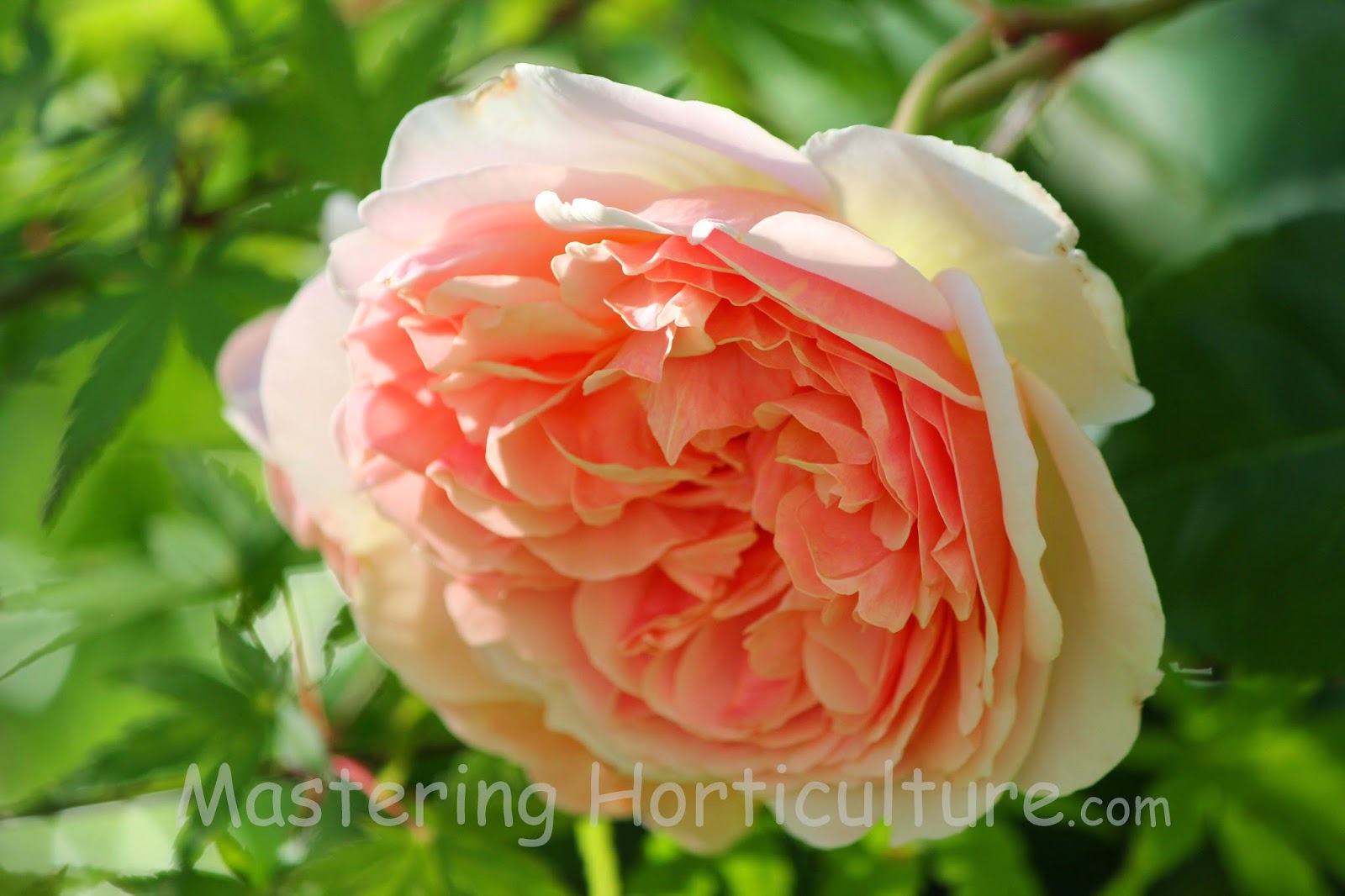
Rosa 'Abraham Darby'  

Roses are beautiful when they are not ugly.  All cultivated roses were selected or bred for appearance and/or in combination with fragrance, disease resistance, vigor and many other desirable characteristics.  They are all beautiful to begin with.  However, we all know that sometimes the promised beauty does not surface due to a number of factors. With more than two decades worth of experience in growing roses in California, I've come to realize a simple truth - there exists no spectrum when it comes to the outcome of the rose. There are only two opposing classifications: beautiful or ugly.

A rose plant growing under optimum conditions and cared for by a conscientious gardener, will come out to be a poetic symbol of beauty, love, fragrance and art.  A rose is a rose when the world is fair. But the world is not always fair.  There are microorganisms lurking everywhere - in the air, in the soil and water - just waiting for the its carrier and opportune moment to charge the garden.    The weather that dictates production rates of plants can be austere or excessive with its blessings and sometimes favors the proliferation of the microscopic society with its ever changing combination of humidity and temperature. All of these natural factors contribute to the outcome of roses.  Then there is the gardeners and his/her management techniques or lack thereof.


Rosa 'Evelyn'

They are beautiful this year.  Their leaves are clean with no significant diseases to worry about at present - hopefully it will stay that way. With the exception of the ones that are shaded by trees, all are growing better than in the previous two years.  The sweet fragrance emanating from the David Austin rose 'Evelyn' is very pleasant that even after many years of purging my rose collection, I thought of checking the rose catalogs again.  :)

Rosa 'America'

Although, the natural factors remain to be out of my control, there were some things that this gardener did that possibly contributed to the excellent performance of the roses during the current season.

1. Deliberate choice and timing of fertilization.  Complete fertilizer (16-16-16) was applied to all my roses right when the new buds were about three inches long and around the time when we had some rain in February.  This is key to the vigor of the roses in the early spring.  A second application was done during the first deadheading.

2.  Limited but regimented watering due to statewide water conservation. Watering is regulated in our area - this time we can only turn on our irrigation systems twice a week.  This means that we are not in danger of over watering the plants and daily exposure to moisture on the leaves.

3.  Increased presence of birds in the garden.  The birds like to linger in the yard with the consistent provision of food and water.  As a result they are also there to peck on bugs before they become a problem.

4.  Improved soil condition through generous application of mulch.  Our pet bunny uses sawdust pellets as bedding material which in turn becomes mulch for the flowers and shrubs.  We all know the benefits of mulch in soil moisture conservation, weed control and soil structure.  And yet, here we have a bunny-enhanced mulch with higher nitrogen content!  Beyond all these perks, the decomposition process of the sawdust reduces the soil pH to some extent.  Since roses prefer a slightly acidic soil, this practice has positive effects on roses.

Rosa 'Sally  Holmes'

Roses are beautiful when they are not ugly.  :)


Monday, January 14, 2013

Streptocarpus: My Own Plant


Streptocarpus spp.
Family: Gesneriaceae
Common Name:  Cape Primrose
Country of Origin: South Africa, Madagascar and  Asia


Fig.1    Streptocarpus flowers intermittently throughout the year.

It's been two and half years ago since I first saw a Streptocarpus in full bloom and the plant was not mine.  This time I have a clone of that same plant which has been growing in my kitchen.

Streptocarpus is probably one of the most beautiful flowering houseplants.  It is regarded in high esteem by plant enthusiasts not only because of its pleasing beauty but also because of its durability  as a plant. It is an evergreen, herbaceous  plant that grows well in shade - making it a great indoor plant.  This stemless plant blooms almost throughout the year as long as it is regularly fed with complete fertilizer (preferably with a high phosphorous content). They are related to the African violets but have a different morphological structure that makes them more appealing than their shorter relatives.

Fig. 2     Flower buds originating from the petiole of a leaf.

One of the most interesting observations on Streptocarpus is that flower buds originate from the basal section of the leaves (Fig. 2).  That's right; the flowers emerge from the leaves.   The first flower bud always grows closest to the axil as seen on the picture above.  The flowers come in clusters and indeterminately arranged on long slender peduncles that extend well above the top of the leaves giving the appearance of floating flowers (Fig. 3 and Fig. 1).  The flowers open in succession which allows a prolonged flower show (Fig. 1 and 5).

Fig.  3.  Clusters of unopened flowers.


Fig. 4  Delicate tubular flower on slender peduncle.

The flowers come with a delicate tubular corolla which extends out into deeply scalloped lips that resemble individual petals (Fig. 4).  The tube of the flower is usually clear white with increasing pigmentation towards the lobes with the lower lips being darker than the upper lips.  The peduncle (stem-like structure that supports the inflorescence) starts out curled and slowly uncurls as it elongates to display the ethereal inflorescence (Fig. 4).

Fig. 5     Flowers open in succession


Cultural Management  

1.  Provide sufficient moisture but not soggy soil.  Over watering is a common cause of damage on the plant.  Water only when the top of the soil feels dry.  

2.  Position plants in light but not direct sunlight.  East facing window sills work best.  Putting plants on a hot sunny window sill will cause burning on the leaves. 

3.  Feed regularly.  Fertilize during watering using low fertilizer concentration (about 25% of recommended rate).

4.  Allow sufficient room to grow.  Divide or re-pot only when the pot is full of roots to the next size using peat-based multi-purpose media.

5.  Deadhead regularly.  Remove spent flowers (including dead leaves) to encourage continued flowering and to avoid Botrytis (Gray Mold) infection.  

6.  Monitor the occurrence of pests.   Regularly inspect plants for white and greenflies, aphids, mildew, and mealy bugs. (These pests can be a problem but so far I have not seen them on my plants.)  It is easier to control pests at the early stage of infestation.


Streptocarpus: a sturdy and delightful flowering houseplant.

Related Posts with Thumbnails