Showing posts with label Seeds. Show all posts

Tuesday, January 17, 2017

Dehiscent Fruits


Fig. 1   Arbus precatorius seedpods in watercolor.
 It is a plant that grows as a weed in the coastal areas of my hometown in the Philippines.
And for the sake of nostalgia, I decided to draw it based on a picture I saw on the internet.


One the subjects I have enjoyed painting recently have been some dehiscent fruits.  These are the fruits that split-open at maturity to reveal or release the seeds in them.  Dehiscence is nature's seed dispersal mechanism.

Sometimes as gardeners we seem to be focused on the flowers especially on ornamental plants such as the Fortnight Lily (Dietes iridioides).  However as a plant scientist, I seem to be more fascinated by the inherent ultimate purpose of the plant which is reproduction.  Flowers are mainly there to facilitate the seed production.  It is for this very reason that the petalss are not very lasting - they fade right after pollination.  The fruits which contain the seeds are the true star of the whole show.


Fig. 2  Dietes iridiodes seedpods in watercolor.
Commonly known as Fortnight Lily, it is a popular choice for the local landscapes because of its heat and drought tolerance. It has beautiful white flowers that bloom in waves from spring to fall.  After the petals fade away, prominent green seedpods take the place of the flowers.  However, during this time of year blackish-gray cracked seedpods hover over the evergreen leaves.

Friday, September 10, 2010

Story of Forgotten Seeds

One month in darkness.

I was delighted to hear that my friend’s son, Erich, announced that he wanted to grow his own avocado tree. Being someone who advocates gardening, I decided to help him achieve this dream; I stated to germinate four avocado seeds for him using my self-proven paper towel and sandwich bag technique that I described in an earlier post.  I kept the sandwich bag that held the seeds near the kitchen sink and close to the window for some light. Emergence was observed beautifully - the radical (the first root) and the plumule (the first shoot) growing in opposite directions. Everything was happening as I had expected.

Once every three weeks I host a bible study group at home.  During each time, I clean the house as if my guests would question my character if they saw something growing in my kitchen.   The avocado seeds were not going to be seen.  So I placed them in the cabinet under the sink temporarily.   They were out of sight...then they were out of my mind.   A month later I found  them...

Death of the main shoot resulted in branching.

Apical Dominance.  The growth from the embryo was thwarted by the lack of light in the cabinet.  The initial plumule and radical died back and apical dominance was broken - allowing several, instead of just one, shoot to grow.   This is similar to the phenomenon that occurs when any plant stem is decapitated or stressed - lateral branching is increased.  Auxin, a phytohormone, is produced in the growing points of a stem or root.  When the dominant stem loses its strength the lateral branches gain power.

Absence of Chlorophyll.  The lack of light is clearly manifested in the color and growth behavior of the new shoots. When plant tissues get any amount of light, the presence of chlorophyll becomes evident. In the case of these seeds, the shoots are white to pink which indicates that they have never seen the light.

Stress on the main root induced the growth of lateral roots.

Another avocado seed is germinating in my kitchen... :)

Thursday, July 1, 2010

Mango Seedling Emerges

June 28, 2010  - First sign of emergence. 

June 29, 2010 - The plumule is out and starting to unbend.

June 30, 2010 -  The first set of true leaves finds light.

July 1, 2010 - The plumule now turns to a stem as the second set of leaves is beginning to differentiate.

After almost a month since the mango seeds were planted, the first sign of life emerges.   The wait was long considering that the seed was already germinating  when planted.  The radicle which is the part of the seed that would grow downwards to become the main root was visibly elongating.  Yet, it still took almost a month for the plumule (which is the part of the embryo that would grow upward) to find its way into the light.

This seedling has a lot of growing and differentiating to do.  It will be interesting to see how this tropical plant performs in this semi-arid temperate zone.  Although it is not much of a tree, it is the first of its kind that I have seen in California.  

Experiment in your garden and learn something new.

Tuesday, June 8, 2010

Germinating a Mango Seed

Cut close on the thin side of the seed to break the seed coat slightly.

In the tropics where mangoes come from, seedlings can be found growing on compost piles or along sidewalks.  The place is humid and hot that seeds thrown away can germinate voluntarily.   Here on the other hand, the air is so dry that this recalcitrant seed has to be treated in a special manner for the seed to grow.  

This spring and all of summer we will be eating a lot of imported mangoes as usual.  I thought that I would try to germinate some seeds and see if they will make a good houseplant.  Avocados for example are sometimes treated as houseplants in places where they cannot grow successfully outdoors. 

What I Did to Germinate a Mango Seed
The mango has a recalcitrant seed which means that it cannot withstand drying and freezing.  The seed needs to be kept in a moist condition immediately after extracting the seed for the fruit. 
1.  Scrape as much pulp as possible from the seed using a knife.
2.  Cut across the thin side of the seed to break the fibrous seed coat.  This will reduce the length of germination period.
3.  Wrap the seed with a moist paper towel to provide the moisture that the seed needs.
4.  Place the wrapped seed in a clear plastic bag and seal it to prevent the paper from drying. 
5.  If necessary re-moisten the paper towel after a couple of weeks.  Return to plastic bag until the radicle (the first root from a seed) starts to protrude after three to four weeks depending on temperatures. 
6.  Plant in a pot (1 gal).  Keep it watered. The process will be long but once the leaves are out the plant will grow a lot faster.

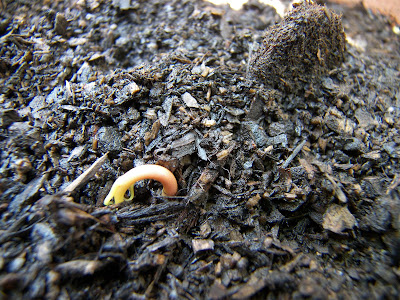
After three weeks inside the plastic bag, the radicle has started to grow.

As soon as I see something happens, rest assured that I will let you know.  I am really curious to see how mango seedlings do on this side of the globe.

Thursday, May 6, 2010

Germination

Before I talk about germination I would like to start by comparing two types of seed based on their water content at maturity:

1.  Orthodox seeds are those that can withstand drying and freezing after maturity.  For example corn (Zea mays) and beans (Phaseolus vulgaris) are traditionally dried after harvesting and sometimes they may be kept in low-temperature environment for storage.  This process helps maintain the viability of the seeds for a longer period of time.  Most annual plants have orthodox seeds.  As the seed matures, its moisture content decreases while dry matter content increases.

2.  Recalcitrant seeds (as in avocado) lose their viability when their moisture content is reduced to a certain level.  Unlike the orthodox seeds, drying and freezing recalcitrant seeds damage the embryo.  Examples of plants with recalcitrant seeds are mango, cacao, and avocado.  As the fruit matures, the seed moisture content increases.  At this point the seed is capable of germination.  Recalcitrant seeds should not be dried after they are extracted from the fruit.   

Germination is the sequence of events in a viable seed starting with the imbibition of water that leads to the growth of the embryo and the development of a seedling.

Monday, May 3, 2010

Avocado Seed

Germinating Avocado (Persea americana) Seed

A fact about the avocado seed.
The avocado seed is a recalcitrant or homeohydrous seed.  Recalcitrant seeds are those that cannot withstand desiccation or drying and freezing.  An avocado seed would loose its viability when dried.  (Viability is the ability of a seed to germinate.) When you are planning to grow an avocado from a seed, it is recommended that the seed be kept moist until the new plant emerges. 

How to germinate an avocado seed?
This is the only method I use to germinate avocado seeds.  It works all the time and it is very easy.  This is better than directly planting the seed in the ground especially in dry places where sufficient soil moisture is hard to maintain.  

1.  Take the seed from a ripe avocado fruit. 
2.  Immediately wrap the seed with wet paper towel.
3.  Place it inside a sandwich bag and seal.
4.  Place the sealed plastic bag with the seed in a warm place (near the window or fridge).
5.  Wait for several weeks until the seeds cracks.  Do not allow the paper towel to get dry.
6.  Continue waiting until the radical (the first root) comes out.
7.  At this point you can plant the seed in a pot or directly into the ground.  
8.  Keep it watered.

This procedure is far more effective and a lot easier than the "toothpick" method.
Related Posts with Thumbnails