Thursday, June 25, 2020

Dividing Fox Tail Agave

 
Fox Tail Agave (Agave attenuata) 

If you are familiar with Agave attenuata, you are aware that they are beautiful plants to have. They make a dramatic statement wherever they are in the garden.  In addition to that they are also easy to grow.  However, they tend to get woody and heavy.   Like most succulents, the leaves serve as water storage and so you can imagine the weight.  They are also very phototropic which means that they tend to grow towards the source of light.  For a while I grew two of these in large pots which are equivalent to five gallons.  They were positioned in the yard against the east facing wall of our house.  They got the milder morning sun and were shaded by the house later in the afternoon. The condition was favorable for their growth, they got big but growing towards only one side.  Soon the pots could not stand without much help anymore because of their weight. 

My plants needed to be repotted two years ago but the job seemed daunting.  I procrastinated.  But during these days we have a lot of time to spare.  I asked my husband helped me.  First of all we had to break the pot - they were totally root bound and there was no way of separating the roots from the pot without breaking the plants - and then break the individual heads.


Agave in our front yard.  It's about to fall on one side.  


These are the things I learned from the process:
1.  Agave attenuata are great for handling, they don't hurt you.
2.  Hand saw works perfectly for cutting the stems apart.  
3.  Remove all the old roots.  The newly cut stems will have to problem growing new roots.
4.  If the stems are too long and they can be shortened by cutting the stem with the saw. 
5.  Soak the ends of the stems in water for a couple of days or plant them directly. 
6.  Separate all the little pups and plant them in appropriately sized pots to have more plants.  
7. The little plants are perfect for giving away to friends and neighbors.


Newly repotted Agave attenuata

Note: In spite of the number of years that I had these plants, they haven't bloomed in my possession yet - in other words they have not shown me their fox tail yet. And for that reason, I still feel more comfortable calling them Agave attenuata. 😃

Some tasks in the garden might seem daunting but when we confront them, we become more informed.

Tuesday, June 23, 2020

Gardening amidst Pandemic

Tulip "Angelique" (April 2020)
2020 is now halfway over.  Covid-19 pandemic has presented the world situations we have never experienced all our lives.  We all had to adapt in our own ways to the threat of the virus and its effects on what we've considered normal.  "Sheltering in place" was something we had never known.  But then one day in March, Governor Newsom of California said we all had to shelter in place to slowdown the spread of the virus.  Some people called it a lock down or quarantine.  We were also instructed to observe social distancing to avoid contracting or spreading the virus. So we did.  Three months later, although some businesses are slowly and cautiously opening, we are still sheltering in place.

One of the things that resulted from sheltering in place and social distancing is that we (my husband and I) acquired more free time.  Time was a gift that came from this unprecedented global disaster.   Busyness, a situation where the time allowance we get in a day is committed to the max suddenly lost its force as a social status indicator.  With the sudden surge of time, we started to spend more of it in the garden either by enjoying; maintaining; or changing it.  We planted more plants and cared for them better than we would have done had we been distracted by travels and social obligations.

Last year I was already planning to change our small front lawn.   Inspired by Monty Don on Gardeners World, I was intent on rewilding or at least increasing biodiversity the  the yard.  The monotonous and water and fertilizer-voracious grass is now old and irrelevant.  For the first step, we planted three Rainbow Ascot euphorbia (1 gal) and two gallardia along the perimeter of the grass. So I bought  some seeds (California poppies) and collected some (Queen Anne's Lace) from the wild during our morning walks with the intention of sowing them in December.  But I missed my schedule and sowed them late.  I think it was already February when I sowed them.  None of the poppies survived but a group of Queen Anne's lace emerged and with some help, they made it.  This year, God-willing, I will sow seeds in the fall.  I'll mark my calendar and ask Alexa to notify me. 

One thing we did according to plan was to plant bulbs: tulips in pots; and alliums in the ground.  Most of the tulips we planted were parrot and peony type.  They were a beautiful and since I have not grown them before, each variety carried an element of surprise as they bloomed in the spring.  The different varieties bloomed in succession and so we enjoyed them longer.  The alliums on the other hand were a complete failure.  We never saw a leaf grow beyond one inch above the ground.  We then made a path on the area where we planted them where they were immediately forgotten.

There are more things we did and are continuing to do in the garden as triggered by the pandemic which I will continue to chronicle in the succeeding posts.


Gardening is a peaceful and therapeutic engagement with nature.  
Grow a plant today.

Wednesday, November 14, 2018

Survival of the Fittest


During the last month and a half, we traveled all over (the world) for one reason or another.  As a result the garden was left to tend for itself most of the time.  Thanks to automated irrigation system, the plants are all fine.  The only problem was that there are some plants scattered all over the yard that are normally hand-watered, just because I like doing it.  Some of them, such as the zinnias, basil, chives, palm trees and some succulents, got severely stressed.  Fortunately, I am not an emotional gardener - I threw away those that did not make it.  The reason they died is that I was attending to more important things in life.  Yes, there are more important things than the garden.  Anyone who is says otherwise doesn't have life :)

Today I was in backyard filling up the bird feeders,watering, and taking pictures when I saw noticed that the grape vine attach itself onto the faucet as if it is trying to get water from it.  It was trying to survive in my absence!  😄

Slowly over the years, my garden has evolved from a high to a low maintenance garden.  First step was to eliminate all that are not supposed to be in my garden such as thorny roses.  They are beautiful plants but they are not always beautiful.  This gardener also does not fancy being poked by plants.  Now, we are at the phase where, the fittest remain.  A plant is fit for my garden if it not only survives but remain beautiful even when I do not tend to it for two weeks or more.  These are the plants that a gardener can enjoy. 


Sunday, March 18, 2018

Some Random Thoughts

Finch: Dining in style

In every garden some life form beyond the gardener's design will appear, thrive, provide, consume, destroy, or invade .  The garden can be artificial in the sense that some things abound beyond the natural.  As a result life thrive there - not only the things we put and plant there but also some others.  One gardening action is not an end but a beginning of a series of changes in the place.  For example, the simple act of digging the soil exposes some weed seeds in the deeper parts of the ground.  Then the seed is exposed to more surface moisture and warmth from the sun.  It grows into a plant called weed.  Soon a butterfly is attracted to the flowers which will soon attract small birds.  The small birds linger around and soon predators will their way to the garden.  Ans do so on.   

Resident Dove

Wildlife, wild as we call them, benefit directly and indirectly from our domesticated yards called gardens.  Here at the Lewis garden, the  mocking birds come to eat their share grapes when the fruits are ripe and what ever we do not harvest, the squirrels will slowly harvest them even when the grapes become dry as raisins.  I think they prefer it that way.  We feed the doves and quails but the hawks and cats come uninvited.  We plant apples to enjoy some fruits but the worms enjoy the first bite.  The same thing is true with all the vegetables we plant.  We dream of nice organic clean lettuce for the salad but the aphids always try to take the first taste.  I guess that is how the world operates.  :)

We change our environment and our environment will change us, hopefully for the better.  That is the point of tending the ground.  Plants we plant change the yard around our homes.  Things come and go; grow and die; produce and consume; beautify and tarnish - because we did something different. And then we see a different world.  Suddenly we realize that we live in a different place.  It is very delightful to see life (plants and animals alike) come and linger around.  They make us slow down and appreciate the things we often take for granted.  And it is all because of a single act we do.  


Hummingbird


Squirrel eating dry grapes


Quails:  Standing room only

Saturday, March 10, 2018

Garden Chores

The first daffodil flower this year.

Things we did in the yard today:
My fellow gardener (aka husband) and I took the time to do some work in the yard on this overcast day.

1.  Remove all old leaves around the yard.   There some areas in the yard where a layer of leaves might be used as mulch.  However there are also areas that are intended to be kept neat and clean - at this time should should be cleaned from all old plant parts.

2.  Empty water from open vessels.  There are always containers or pot saucers in the yard that collect water when it rains which need to be emptied to discourage mosquitoes from breeding in them and to protect the roots of plants in containers.

3.  Fill up bird feeders.  The birds are not only delightful to watch but they are also helpful in eating some of the pests around the yard.

4.  Spread snail bait and pesticide (granules) for soil-born insects such as grubs on the lawn area.

5.  Fertilize the lawn.  At this time of the year, complete fertilizer, such as 16-16-16 helps the grass develop not just the part that are seen but also the the roots which is necessary for our dry area.  The better root system the plants have, the better ability it has to search for water and other resources during the drier months.  With that said, my fellow gardener decided to use the Weed and Feed from last year.  It contained a high dose of nitrogen (28-0-2) and some herbicide (2,4 D).  High levels of nitrogen is not needed by the grass at this time but it's not detrimental, so no big deal.  The problem was the herbicide in the fertilizer because I saw him spreading it around the succulents!  We'll see what happens next.  :)

6.  Prune shrubs.  Rosemary, Mexican sage, Santa Barbara daisies.

7.  Fortified the surrounding hollow blocks of the compost pile.


Mint:  Expelled from the vegetable plot.

8.  Remove mint runners from vegetable plots.  I left one mint plant outside the container last year and this time there are new mint everywhere.  I knew it was going to happen but I did not anticipate how far they would go within a year.  :)

9.  Mow the grass.  The grass needed a little haircut today.  And it looks better now.

After we got done with yard work, we had lunch and then watched the Masterpiece movie "Great Expectations".  I think we deserved it. :)

Every day spent tending the garden is a beautiful day.

Friday, March 9, 2018

Super Sugar Snap Pea

Pea 'Super Sugar Snap' (Pisum sativum) Seeds

Today marks the beginning of spring in my garden because the first seeds that would grow in my little garden this year just got planted.  Our weather here can change swiftly from cold (Foothills-cold) to hot (Inland-hot) which poses a challenge in  scheduling to plant any of the cool season crops such as peas.  In previous years, the consistent problem has been having the temperatures get critically high before my peas produce pods.  Hopefully this time will be different.

Super Sugar Snap is an earlier variety, maturing within 64 days from planting.  It is supposed to have shorter veins than the older varieties which would make it snap better and more fun to eat.  Another favorable feature of this variety is its high resistance to powdery mildew and leaf roll virus. We need to understand that the conditions that favor the growth of powdery mildew is the same as the conditions required by the most of the cool-season crops: High relative humidity (RH) at nighttime; drier or low RH during daytime; and mild temperatures (70-80 ºF).  Therefore, in choosing a variety, diseases resistance must be given special consideration. 

Every day spent tending the garden is a beautiful day.

Monday, January 15, 2018

Dusty Miller


Dusty Miller (Jacobaea maritima) is a unique plant with silvery and lacy leaves which varies with variety.  which made it useful in creating contrast and accent against the predominantly green or red foliage in the garden.  It's neutral color makes it a great choice for as a filler plant in any border.


Last season, I planted dusty miller along with marigolds and blue lobelia and alyssum in the large containers that hold orange and pomegranate trees.  The arrangement was delightful all the way to the late fall.  But now only the silvery dusty miller remains.   Dusty miller, as much as it is labelled as an annual in your local nursery, is a perennial.  Yes, dusty miller is a perennial plant.


When the plant gets to a mature stage, the shape becomes irregular and the stems get woody.  The plant seem to undergo bolting at flowering.  However,  this can be solved by pruning the plant to shape.  As for the ones I have in my containers (as seen in the picture below) they will soon be transferred to the ground before I plant new annuals into the containers again.  


Tuesday, December 5, 2017

Aeonium haworthii: Survival Mechanism

Fig. 1    Aeonium haworthii 'Pinwheel' 

Aeonium haworthii (Pinwheel) is a succulent species in the Crassulaceae family. Because this plant has been growing in my garden for so long, I am a witness to the behavior of this plant at least in our USDA Zone 9 area.  It is a sturdy plant which can thrive with minimal care.  The winters here are harsh and summers are very dry and very hot and yet there has been no mortality to account for - the plant just doesn't die.  However depending on the microclimate and eventually the plant may undergo some levels of stress in the drier months.

Fig. 2    Curled in leaves:  Behavior of stressed plants

This year we had recurring problem with faulty drip irrigation where some plants were not getting watered and among them were the 'Pinwheels'.  And because they are succulents it takes longer before physical signs of stress become noticeable.  Sometimes when the symptoms become visible, the physiological stress is already at an advanced stage. Symptoms happen is stages.  Firstly is the yellowing of the lower leaves on the stem.    Then these leaves abscise (fall off the plant), but that is easily ignored as the more prominent parts of the plants are still normal.  Then the third stage is more recognizable:  the leaves begin to curl in to form a seemingly closed flower as in Fig. 2.  This the the point when even the untrained eye will notice the symptoms.

So several of my plants exhibited this third stage.  But my point here is to give emphasis to the ability of the plant to survive after it has undergone critical conditions.  It has been my observation that when stressed-plants experience the first sign of favorable condition, through rain or watering, they respond very quickly.  Adventitious roots grow (Fig. 3) from older stems at a very fast rate to take advantage of the moisture - first in the atmosphere and then into the ground.  This is one of the many survival mechanisms succulents rely on - which makes them withstand severely stressful conditions.

Fig. 3     Adventitious roots appear when favorable condition are sensed by the plant.

When a stem of this succulent plant is separated from the plant, it will behave as if it is the last of its kind and thus try to preserve its species (Fig. 4).  It will heal all wounds that potentially pose as outlets of the remaining water stored in its tissues.  The leaves protect the tender growing point and conserve moisture by curling in its leaves.  Dried as it may seem, the detached stem is ever sensing changes in the atmosphere.  Once favorable conditions occur, root growth commences  (Fig. 4).

Fig.  4     Detached stem of Aeonium haworthii 'Pinwheel' displays survival techniques.

Succulents are interesting plants indeed.

Thursday, November 30, 2017

Kalanchoe Panamensis: Hidden Flowers

Kalanchoe panamemsis flowers:  dimpled heart-shaped pendants.

Since I started painting, I have become more observant of the little details of plants.  The desire to portray plants parts accurately, summons me to look at them more intensely than I used to.  Yesterday as I was walking in the secret garden (one section of my yard) where some succulents grow, I noticed something different with the Kalanchoe panamensis.  Some of the leaves seemed lacking the magenta color on leaf margins.  The initial question was, could it be that the terminal ends of these plants lose the pigmentation when the temperatures are low?  But upon close observation, it turned out that the plants were in bloom.  Then the next question was, why only now?  This plant has been in my garden for years.  Could it be that I was less observant then?  Or could it be that I was just not in the garden when flowering occurred in the past?


The flowers are generally light in color but some pigmentation were visible on random buds.

The Kalanchoe panamensis blooms on the terminal ends of the stems.  At this stage, the flowers look like heart-like pendants that hang in clusters.  They are beautiful now.  But I expect that these flowers still have to undergo several development stages.  And since all flowers must open, I'm excited to see how these ones will pave the way for pollination to happen.  Stay tuned. 😊

Kalanchoe panamemsis before flower initiation

Stroll in your garden and learn something new.  

Wednesday, November 29, 2017

It's Been Awhile...

Pomegranate 'Wonderful'

That' right, it's been almost six months since I posted here.  For those who have been following this blog, I apologize for the long silence.  Last year sometime in April,  I picked up a pencil and started to draw plant parts.  Then I realized I was challenging myself to learn botanical art without any training.  In other words I was and still am self teaching.  Needless to say that I have been enjoying my baby steps. However, time and time again, I am conflicted because writing about horticulture and photographing plants/gardening are like my old friends whom I love.  A big portion of my creative time is now devoted in getting to know my new friend - painting.  And yet, the only reason I love painting is because of my interest in horticulture.  Indeed they are NOT two different friends - they are one art - just expressed in different media.  Anyway, my initial point was to explain my long absence in the blogosphere and I resolve to make more frequent appearance here in the future. 😊

New in the garden this year are three abutilon varieties. 

The hummingbirds enjoyed the abundance of nectar.
Currently my garden is getting ready to go into its winter break.  It was a good productive year overall with the exception of the grapes which were heavily infested with Leaf-hopper (Ciccadellidae).  This is the first year in a long time when we did not make grape molasses. Sigh. Fortunately, there is always the promise of the next year.


Bartlett Pear:  The golden days before winter.


Thursday, May 25, 2017

Herbs - Spice Up Your Garden

Chives and Garlic chives

Herbs play a significant role in the flavor structure of a given dish.  The world, although geographically separated, are defined by the culinary flavors as determined by the indigenous herbs on top of the food available in the land.    Modern technology has allowed plants to  cross geographical borders and to be cultivated far from their places of origin but the different cultures have long been steeped in the herbs that they had from time immemorial.   For example, garlic chives and garlic with fish sauce and vinegar says Philippines;  the combination of mint and oregano with Feta say Greece; curry (a mixture of many herbs and spices) and coconut and some spicy peppers say Thailand; Wasabe on soy sauce and seaweed say Japan - just to name a few.  That is reason that sometimes the addition of a specific herb to your dish at home brings back memories of a place that you once visited.

However the reason I'm writing this article is to remind home gardeners that herbs should be part of every garden.


French Tarragon

Herb Garden..  Herbs are better when they are fresh when their aroma has not left them yet.  That is why some grocery stores now carry live herbs that you can grow in your kitchen.  But believe me, they don't do well in the kitchen unless you they get at least four hours of sun in there.  The best solution to having a good and prolonged supply of herbs is to have an herb garden - even if it is done in a container.    It does not have to be sophisticated; a good-sized container and some potting soil and some hours of direct sunlight.


Italian Basil

Choose Herbs That You Like.  There is nothing more useless than planting herbs that you do not use.  Well, I take that back because if you don't use them they will flower and attract bees - which is a good thing.  But if you grow herbs for culinary purposes then you better plan on the ones you like on your food and actually use.  Keep using them to encourage new growth.  Clip off the flowers to keep them going for a while.  And for annuals you might want to plant a second batch.  

Since most annual as well as perennial herds produce mostly in the warmer months, it is a good idea to preserve some of your harvest.  The Internet provides a vast information on how to preserve the different herbs.  As for my family, we like to make basil pesto in the summer - then freeze them.  We seem to always have frozen pesto in the freezer ready for use in various dishes.  This year, because we planted a lot of cilantro, we might have enough to make cilantro pesto. 

Near the Kitchen.  There is a great benefit in growing herbs in places where they are visible from your kitchen.   Sometimes we pull out the drawer in the fridge to check what herbs we have but won't it be nice to look out the window to see which herb you can use for your dish?  When we can see them from the kitchen window we get reminded to harvest them and sometimes to water them - especially during the hot summer days. 

Cilantro (Coriander)

Every home should have a functional herb garden, I think.  

Sunday, May 7, 2017

Eden Rose (2017)

Rosa 'Eden': Beautiful romantic rose.

The glorious time for Eden rose has come to my garden once more.  It is blooming!  It is a beautiful romantic rose.  However, the subtlety in its color and fragrance is offset by its exuberant growth habit and the extravagant inflorescence.  The flowers are composed of thick piles of overlapping  petals - making them so heavy that makes them always in a drooping position.  It is a good thing that this rose is a climbing type because it is better to appreciate the flowers from below.  


Rosa Eden: Exuberant growth habit and extravagant inflorescence.

Owing to the season of abundant precipitation we had after a long drought, all my plants are generally performing good this year.  However, good things seem to come with some challenges.  In the case of this rose, I had to prop the canes temporarily to prevent them from breaking due to the heavy weight of the flowers.  

Clematis 'Niobi rambles on Eden rose.

One of the things I have done  in the past years is to plant clematis among my climbing roses.  In the pictures, you can see Clematis 'Niobi' rambling among the roses.  I found this to be good especially with roses that bloom heavily in the spring and sparingly afterwards and those that are prone to diseases that cause some defoliation.  The clematis provides the necessary color and interest during the ugly period of the roses.  Yes, I always say that roses are beautiful when they are not ugly.  And I am always in the business of trying to mitigate this problem of ugliness on the plant that is supposed to be a bearer of the symbol of beauty.

Roses are beautiful...

Tuesday, April 25, 2017

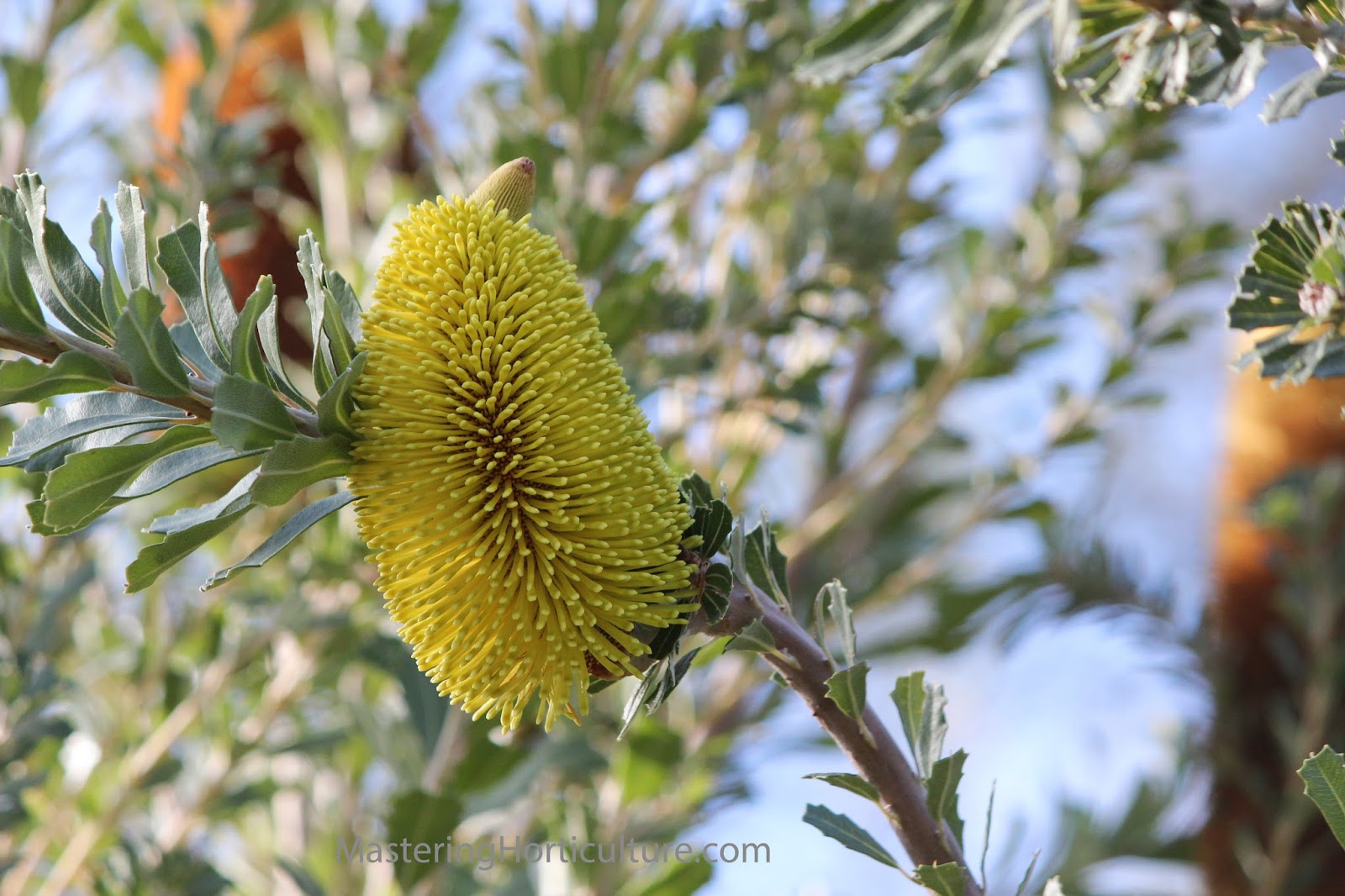
Banksia integrifolia

Botanical Name:  Banksia integrifolia
Common Name:  Coastal Banksia
Family:  Proteaceae
Country of Origin:  Possibly Eastern Australia
Named after Sir Joseph Banks


This picture was taken at the UC Davis Arboretum.   The flowers were very striking and hard to miss. I noticed at least two specimens of Banksia during our recent visit there but I am not sure what varieties they are.  

Monday, April 24, 2017

Wildlife Refuge

Hummingbirds eat nectar and small insects.  

"If you feed them they'll come..."  That is true to most of nature.  Living things can sense the direction of the source of good things and tend to gravitate towards it.  Life was designed that way for survival.  In the case of plants, their roots grow toward moist areas and the leaves towards the light.  If plants that seem so immobile can get to the food how much more to those that are equipped with wings and legs?  

Yes, I'm referring to the birds and other small mammals that now seem to reside in our garden because we have been regularly giving them food.  In return they give us entertainment and they help with pest control by eating aphids, larvae, slugs and snails that have found their way to my garden.    

There are so many wild doves in the area but we got our resident ones.

All of these birds can be attracted to a garden depending on the plants growing around.  However, in the absence of plants they can be lured by providing them feeds and water.  During summer time, water is as important as the feed in attracting them to the garden.  

He's cute but he scares the birds from the feeders.

The other thing that make a garden bird-friendly is the presence of bushes that provide shelter and cover from predator.  In our garden, the boxwood hedges provide just that to the finches when the hawk tries to get to them.

Broken saucers can still serve as a feeder.


Old breads are not wasted.  

When the quails are around, they bring down the snail population.

If you want to make your garden more interesting this season, try attracting more birds into it. 

Even doves enjoy the hammock in the garden

Birds are good boarders, they pay their fees in terms of entertainment and pest control.

Tuesday, January 17, 2017

Dehiscent Fruits


Fig. 1   Arbus precatorius seedpods in watercolor.
 It is a plant that grows as a weed in the coastal areas of my hometown in the Philippines.
And for the sake of nostalgia, I decided to draw it based on a picture I saw on the internet.


One the subjects I have enjoyed painting recently have been some dehiscent fruits.  These are the fruits that split-open at maturity to reveal or release the seeds in them.  Dehiscence is nature's seed dispersal mechanism.

Sometimes as gardeners we seem to be focused on the flowers especially on ornamental plants such as the Fortnight Lily (Dietes iridioides).  However as a plant scientist, I seem to be more fascinated by the inherent ultimate purpose of the plant which is reproduction.  Flowers are mainly there to facilitate the seed production.  It is for this very reason that the petalss are not very lasting - they fade right after pollination.  The fruits which contain the seeds are the true star of the whole show.


Fig. 2  Dietes iridiodes seedpods in watercolor.
Commonly known as Fortnight Lily, it is a popular choice for the local landscapes because of its heat and drought tolerance. It has beautiful white flowers that bloom in waves from spring to fall.  After the petals fade away, prominent green seedpods take the place of the flowers.  However, during this time of year blackish-gray cracked seedpods hover over the evergreen leaves.

Friday, January 13, 2017

Colorful Flapjacks

Older leaves turning yellow while the flower stalk remaining bluish gray.

Kalanchoe luciae 'Flapjacks' are very interesting succulents because of their flat leaves with colors that seem to change with the seasons.  I noticed that during seasons when the plants undergo stress, such as heat, drought and cold, the leaves tend to carry a warmer yellowish color starting from the older leaves.  In the spring and fall seasons, the red color intensifies with a hint of blue near the growing points of the plant.


'Flapjacks' make succulent specimen for containers and the garden. 

Thursday, October 27, 2016

Why Pomegranates Crack Open


After we had the first real rain this month, I saw that some of the fruits from the pomegranate tree cracked.  The plan was to keep them on the tree till December so that we will have an abundance of red color in the kitchen.  But I guess we'll just have to eat some of them sooner.  :)

Why do pomegranates crack or split?
 
1.  Sudden increase of available moisture at maturity.  When the fruits are mature and a sudden increase of available soil moisture occurs, as in the case of rain, some of the fruits responds by splitting.

2.  Inconsistent watering.  Sometimes fruits split when watering is inconsistent.  When the plants undergo incipient wilting prior to watering, the fruits tend to split.  This phenomenon can also be observed in other crops like tomatoes during the summer after a spell of hot weather and plants are given more water to compensate for the wilting.

3.  Some varieties are more susceptible to splitting than some.  Although I would say that genetic attributes of a plant fail to deliver when cultural management are not up to par.  This pomegranate in the picture is 'Wonderful', known to be resistant to cracking.  But because it is growing in a container, the soil is often on the side of dry.  While the tree can survive on less water, the sudden rise in available water triggers extreme physiological changes defying that which genetics was meant to accomplish.


When the pomegranate fruits crack open, it must be time to eat them.  :)

Wednesday, October 19, 2016

Picture of the Day: Guttation on Broccoli


Beautiful guttation!  I was inspecting my broccoli plants for bugs when I saw this beautiful beads dangling on the edges of the leaves.  They are just a reminder that we had a good amount of precipitation during the last couple of days.  And because this is California, we get some really nice sunny weather afterwards providing the conditions for guttation to occur.

For more information about this phenomenon, read my earlier post on Guttation.

Stroll in your garden regularly.  
There is always something to discover there.

Saturday, October 15, 2016

Aphids on Napa Cabbage


My battle with pests continues.  When I thought the cabbage worms on the kale have been eradicated, I found another colony of insurgents on the underside of the Napa cabbage leaves -- Aphids!  What looked like soil particles are pests sucking the life out of my plants.  Aphids are very tiny insects but they are not to be taken for granted because of their ability multiply at an alarming rate.

Aphids are parthenogenetic.  They have the ability to reproduce asexually.  They can reproduce without mating - giving birth to multiple live offspring in a day (1).  Not all of theme  have wings but they have some allies - the ants - that can move them from one place to another better place.

So what do you do when you find out that your young plants are infested with aphids?  When it comes to my kitchen garden I resist the temptation to spray anything store-bought for as long as possible.  In other words, pesticides are my last recourse.   At the first sign of infestation, aphid colonies can be easily disrupted by spraying them off with water.  Repeat daily until they are gone maybe about three to four days depending on how severe the infestation.  If you think they are beyond water-treatment, I would use Neem Oil or other plant-based pesticides.

In addition to this, there are also beneficial insects that are naturally around your garden such as ladybugs (Coccinella septempunctata) and lacewings (Chrysoperla rufilabris).  To increase their population in your garden you can buy them from your local nursery and let them out where the problem is most severe.

After all the secret is not in the toxicity level of the pesticide but the conscientiousness of the gardener in regularly inspecting the garden.  When the problem is caught early, it is manageable.


Stroll in your garden.  
It is good for you and your plants.  :)

__________
1 Integrated Pest Management (UC)
Related Posts with Thumbnails