Saturday, August 24, 2013

Bitter Gourd


Momordica charantia L.
Family:  Cucurbitaceae
Common Names in the US*:  Bitter Melon; Bitter Gourd; Balsam Pear

One vegetable vigorously growing in my garden at this time in the season is the bitter gourd (Momordica charantia L.).  This vegetable was a part of my everyday diet in my earlier years.  Sadly, it has increasingly become a rarity since I moved to California.  But this trend is soon to be reversed. With my success this year, bitter melon may yet become a regular item in my summer garden.


Bitter melon is an important vegetable crop in the Philippines and all of Asia.  The fruits and leaves are edible - both bearing a strikingly bitter taste that varies in intensity depending on variety.  

In my village, bitter gourd is believed to be purgative.  Newborn babies (before their first taste of their mother's milk) are given a teaspoon of bitter melon tonic - pure extract from the leaves of the plant. This blackish-green delight is bitter enough to squeeze every facial muscle of the infant.  As if this is their initiation into the world.  However, this does not diminish the fact that bitter melon is an acquired taste even to Filipinos.  For my grandmother, the more bitter the parya (Ilocano word for bitter melon) the better it is.  But to my grandfather, parya and food did not go together.
   
In the bigger world, bitter melon has gone a long way.  Extensive research has led to understanding the medicinal properties of the plant down to molecular levels.  Bitter gourd has emerged to be one of the most significant botanical remedies for type 2 diabetes.  Recently,  AVRDC - The World Vegetable Center spearheaded a project called the Bitter Gourd Project which "aims to improve the incomes and health of the poor in developing countries, particularly the quality of life of diabetics, through scientific research on bitter gourd (Momordica charantia L.)."  But as for me, bitter gourd or bitter melon is just one of my favorite vegetables in the world.  


Now let's talk about the plant. 

Bitter gourd is tender perennial - in this area it is treated as an annual plant.  The vine grows eight to ten feet in length with robust branching and foliage growth.  It looks delicate but its every node bears a tendril that allows the plant to secure itself easily on trellises or other plants.  The palmately lobed leaves are beautiful.  

The flowers are bright yellow and very fragrant.  Just like all other plants in the Cucurbitaceae family, the bitter gourd is a monoecious plant - having separate male (staminate) and female (pistillate) flowers on the same plant.  Only the pollinated female flowers turn into fruits. 

Fruits of bitter gourd are generally warty with colors ranging from dark green to white.  They can be small and rounded (one-inch diameter) to large and elongated (3-inch diameter and 15-inch long).  The plants growing in my garden have small and elongated fruits with an average length of 3 inches.  

Growing Bitter Gourd
  1. Choose sunny location - afternoon shade in hotter climate like mine.  Bitter gourd can be grown directly into the soil or in containers. Mine is growing in a five gallon bucket.
  2. Incorporate compost or decomposed animal manure into soil.  
  3. Plan and install support structures for plants (I attached wire mesh on the fence but you can used bamboo stakes or trellis). 
  4. Direct sow plants in warm soil after the last frost.  Water the seeds thoroughly.  It takes about a week for seeds to emerge.  
  5. Protect seedlings from snails and slugs - I've learned it the hard way.
  6. Water regularly to keep soil moist but not wet.  
  7. Mulch to conserve soil moisture and reduce weed growth.
  8. Fertilize bitter gourd when there are two tendrils stretching out of the stem.  Repeat every two to three weeks. 
  9. Yellowing of the leaves can be a sign of nutrient deficiency.  Remember:  Low-dose fertilizer applied frequently is better than high dosage at a less frequent interval.  
  10. Check for pest and diseases regularly.  
  11. Harvest fruits when they are green and shiny.  When fruits begin to turn yellow then it is too late.


Have you ever grown bitter gourd in your garden?  And have you eaten bitter gourd before?  What did you think? 

Tuesday, February 26, 2013

Dioscorea macrostachya

 Dioscorea macrostachya 
Synonym: Dioscorea mexicana
Family:  Dioscoreaceae
Common Name:Tortoise Plant
Country of Origin: Panama, El Salvador, Mexico


Fig. 1  Caudex on close-up view - resembles a tortoise shell.


The caudex which is the thickened and enlarged base of the stem is what gives this plant an extraordinary visual appeal.  Part of the caudex grows above-ground exposing a hardened outer layer that resembles a tortoise shell .  As the caudex expands, the hardened layer breaks into almost regular polygonal plates that becomes protuberant with age leaving deep furrow in between (Fig. 1).  

Fig. 2  Flowers and leaves on long vines

The pictures here are images of the specimen Dioscorea macrostachya at the Conservatory of  Flowers in San Francisco.  From the appearance of the stem and leaves, this perennial plant looks like and ordinary vine (Fig. 2).  Capable of growing up to 36 feet in a year, this plant is a vigorous grower.   Unless you take the time to  guide your eyes to follow where the vine originates, it would be so hard to imagine that the caudex below (Fig. 3) is related to the far-reaching vine with the heart-shaped leaves.  

The plant  

Fig. 3    Branches arising from the caudex.


As a normal sequence of events, every year, a new set of branches emerge from the apical end of the caudex and dies back at the end of the season depending on growing conditions.  In the tropical forest where this plant would be found in nature, the caudex would be sitting in the shade where it prefers to be with lots of water.   Sunlight requirement for this plant is relatively moderate.  The new vine would then have to reach up above the other plant canopies to access to direct sunlight.  Thus a rapid growth of the vine is necessary for existence.  The rate of growth of the caudex is a function of the photosynthetic rate on the foliage.  


Fig. 4      The Caudex: Tortoise-like


Dioscorea macrostachya is grown as an ornamental plant as it adds oddity to any plant collection.  


Suggested reading on Caudiciforms:
http://www.bihrmann.com/caudiciforms/subs/dio-mex-sub.asp


Find time to walk in a garden today.


Friday, February 8, 2013

Japanese Tea Garden - San Francisco


Stone Lantern

My family was in San Francisco for a weekend getaway last week.  Guess what places ranked high on the list of preferred destinations.  Gardens.  January is not the best time to see flowers but it is definitely a great time to see the bones that makes a beautiful landscape.   We toured most of the horticultural points of interest inside the Golden Gate Park.  One of the places we went to see was the Japanese Tea Garden, which is claimed to be the oldest public Japanese garden in the country.  

Stone statue

What is A Tea Garden anyway? Originally, a tea garden was intended to be a serene place to prepare the mind prior to entering the tea house.  In the tea house a tea ceremony (as taught by Sen no Rikyu) is performed.  By design, the tea garden avoids artificiality in an attempt to emphasize the natural appearance of the environment.  According to literature, the stone lantern, stepping stones, clusters of trees and shrubs, and gazebos that are incorporated in modern-day Japanese gardens have their origin in the tea garden.


The Japanese Tea Garden in San Francisco successfully integrated all the mind-calming elements of a ceremonial garden.  Although they do not offer Tea Ceremonies at this time of the year, they offer an excellent selection of teas at the gazebo.  We tried some of their teas and enjoyed a tray of mochi.  However, with the number of tourists milling around, one can hardly experience the garden-inspired peace and meditation.  Thank goodness we were there for the aesthetics and not the spiritual experience.


Carefully trained trees

The lack of flowers forced me to focus on the characteristics of a Japanese.  I thought about the serene look of the garden and what contribute to all that.  A few things stuck out.  The garden mimics natural landscapes but presented in reduced scale.  The trees are severely clipped and controlled to regulate their size. That is why topiaries are prominent fixtures in Japanese gardens.   Stones, used to mimic larger things in nature, are spread throughout the garden.  I noticed that water is an essential element of the garden. Fountains, ponds, and miniature-falls bring coolness to the garden.


Metal and wood combined give a sense of strength on the gate..

Sound and motion from water fountains contribute to the calming effect of the garden.

Stone-trough and rocks give the impression of permanence while mimicking views of boulders and ponds. 

Intricate details on buildings add elegance to natural construction materials.

Stepping stones suggest a regulated walk in the garden - allowing time to appreciate the surroundings.

Still waters multiply the effects of the garden elements.


Gardens that are mature are a great source of inspiration.  Take the time to stroll them.  

Saturday, February 2, 2013

Super Bowl 2013: Go 49ers!


The Bay Bridge

We were in San Francisco last week visiting some of the horticultural points of interest at the Golden Gate Park.  As we approached the Conservatory of Flowers we saw recent plantings of succulents (Echeveria spp.) on both sides of the stairs that lead to the building.  The city is very proud of its team.  People show their support with their T-shirts, cars, cakes, hats...but the one that I favor the most is the one that is expressed through the gardens.  


Writing with Succulents

 "Rooting" with Succulents  :)


Happy Super Bowl, Everyone!


Monday, January 28, 2013

Succulents: Survivors of the Winter

Aloe spp.

When planning for hot and dry condition planting, succulents are often among the top candidates because of their ability to withstand prolonged periods of drought.  On the other when it comes to planning for winter interests, seldom do they ever get recommended.  This could be because of an unspoken assumption that when a plant is heat tolerant, it does not like the cold.  This assumption is not valid.  Like all gardeners who have grown some of them, I can say that with the appropriate variety and suitable location in the garden, succulents can be among the few interesting plants in the dead of the winter.  While the rest of the traditional plants go into dormancy, some succulents continue to grow changing their colors in response to the temperature and light intensity.

Echeveria 'Neon Breakers' (Fall)

Echeveria 'Neon Breakers'  (Winter)

Succulents cover a wide range of plant species that originated from places of varied climes.  Some have come from the tropics (rain might be prevalent but some succulents grow on trees where the roots cannot reach the ground); arid regions (deserts have low rainfall and high temperatures that limit water supply); coastal areas (water may be available but it is usually loaded with high levels of salts and minerals - beyond the threshold levels for most plants); and the alps (precipitation may come fresh in relatively larger quantities but it is frozen and unavailable for plant consumption).  With that in mind, it is not surprising that some succulents respond differently under varied  environmental conditions. And that is why, some succulents can be winter gems even in temperate areas.

Aeonium 'Kiwi'


      Sedum rubrotinctum 'Pork and Beans'


Succulents is the collective term for drought-tolerant plants with the characteristic thickened fleshy organs (leaves, stems, or roots).  Whether the plants evolved (over the years) to come up with this type of specialized fleshy tissues as survival mechanism or whether they were originally endowed with such characteristics the first time they sprouted in the Garden of Eden, I am not sure.  However, if such character traits of succulents allow them to survive the extreme dry conditions, how much more would they favor the plants that are grown in gardens where almost everything is manipulated to provide favorable conditions for the plants?

Wooly Rose (Echeveria cristata 'Doris Taylor')

California is known for its generally mild climates but my garden - being in the foothills of the Sierras - experiences both ends of the thermal spectrum.   We have very hot summers and freezing winters.  Over the years I have observed that only few of the succulents in my collection are susceptible to the cold.  In fact most of them are very resilient and they display very interesting colors during the colder months.


Aeoniums, Sempervivums, Aloes, and Sedums are among the ones that consistently do well in my garden.  Others like Echeveria also do well depending on variety and microclimate. The earlier they get the morning sun, the better - as this would shorten their exposure to freezing temperatures.  Although succulents prefer some amount of shade in the summer, plants that are placed on the south-facing side of the garden have a better chance of withstanding the harsh winter nights.

   
With the right variety and microclimate, succulents can be the garden gem that sparkles in the winter.

Monday, January 14, 2013

Streptocarpus: My Own Plant


Streptocarpus spp.
Family: Gesneriaceae
Common Name:  Cape Primrose
Country of Origin: South Africa, Madagascar and  Asia


Fig.1    Streptocarpus flowers intermittently throughout the year.

It's been two and half years ago since I first saw a Streptocarpus in full bloom and the plant was not mine.  This time I have a clone of that same plant which has been growing in my kitchen.

Streptocarpus is probably one of the most beautiful flowering houseplants.  It is regarded in high esteem by plant enthusiasts not only because of its pleasing beauty but also because of its durability  as a plant. It is an evergreen, herbaceous  plant that grows well in shade - making it a great indoor plant.  This stemless plant blooms almost throughout the year as long as it is regularly fed with complete fertilizer (preferably with a high phosphorous content). They are related to the African violets but have a different morphological structure that makes them more appealing than their shorter relatives.

Fig. 2     Flower buds originating from the petiole of a leaf.

One of the most interesting observations on Streptocarpus is that flower buds originate from the basal section of the leaves (Fig. 2).  That's right; the flowers emerge from the leaves.   The first flower bud always grows closest to the axil as seen on the picture above.  The flowers come in clusters and indeterminately arranged on long slender peduncles that extend well above the top of the leaves giving the appearance of floating flowers (Fig. 3 and Fig. 1).  The flowers open in succession which allows a prolonged flower show (Fig. 1 and 5).

Fig.  3.  Clusters of unopened flowers.


Fig. 4  Delicate tubular flower on slender peduncle.

The flowers come with a delicate tubular corolla which extends out into deeply scalloped lips that resemble individual petals (Fig. 4).  The tube of the flower is usually clear white with increasing pigmentation towards the lobes with the lower lips being darker than the upper lips.  The peduncle (stem-like structure that supports the inflorescence) starts out curled and slowly uncurls as it elongates to display the ethereal inflorescence (Fig. 4).

Fig. 5     Flowers open in succession


Cultural Management  

1.  Provide sufficient moisture but not soggy soil.  Over watering is a common cause of damage on the plant.  Water only when the top of the soil feels dry.  

2.  Position plants in light but not direct sunlight.  East facing window sills work best.  Putting plants on a hot sunny window sill will cause burning on the leaves. 

3.  Feed regularly.  Fertilize during watering using low fertilizer concentration (about 25% of recommended rate).

4.  Allow sufficient room to grow.  Divide or re-pot only when the pot is full of roots to the next size using peat-based multi-purpose media.

5.  Deadhead regularly.  Remove spent flowers (including dead leaves) to encourage continued flowering and to avoid Botrytis (Gray Mold) infection.  

6.  Monitor the occurrence of pests.   Regularly inspect plants for white and greenflies, aphids, mildew, and mealy bugs. (These pests can be a problem but so far I have not seen them on my plants.)  It is easier to control pests at the early stage of infestation.


Streptocarpus: a sturdy and delightful flowering houseplant.

Sunday, September 2, 2012

HortiCOOLture - Armored Plant

Fig. 1   The bizarre porcupine tomato (Solanum pyracanthum).


Ornamentally Odd
When all the basic plants are in place in the garden, an oddity here and there is in order.  This week our local nursery is offering a plant that would fit the bill.  The "Porcupine tomato" botanically known as Solanum pyracanthum (Fig. 1) is a plant that is armored with spikes all over. 

In spite of being prickly, some ornamental features can be attributed to this plant.  The bright orange spikes provide a pleasing textural and color contrast against the bluish green velvety leaves (Fig. 2).  The royal purple petals are complemented by protruding yellow stamens in the middle.   Eventually, small cherry-tomato-like fruits will take the place of the colorful flowers. A plant with such attributes definitely makes a statement in any garden.


Fig. 2   Dagger-like spikes on land under leaves of Solanum pyracanthum


Physical and Chemical Threat
This may be an ornamental shrub but the plant is definitely for your eyes only. The velvety green leaves may look soft and friendly but the dagger-like spikes (Fig. 2) that are spread all over the plant  make the plant look utterly foreboding.   I would not recommend this plant near playground areas.  The quills would deter any one from touching the plant but the danger does not end there.  The plant is known to contain various toxic substances on the leaves, stems and fruits - just like most solanaceous (night shade) plants.   Because of this, it is not clear whether the spikes were meant to protect the plant from humans and animals or vice versa


Fig. 3  Solanum pyrachantum flower.
 
porcupine tomato
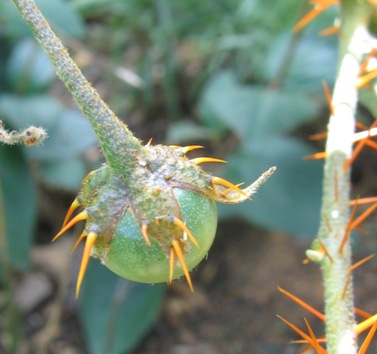
 Fig. 4   Armored fruit of Solanum pyrachantum. (Photo from Rob's Plants)
 
 
Threat of Invasion
The plant is drought tolerant therefore caution should be observed when it comes to cultivating this plant since it can be invasive depending on the growing conditions.  The fruits are loaded with seeds which when allowed to mature and fall on the ground will result in an explosion of new seedlings.  Eradicating an army of plants like this, would involve a bloody battle.  :)  


 Solanum pyrachantum, although related to food crops like potato, tomato and eggplant, has been cultivated solely as ornamental plant.  And we will keep it that way! 
Related Posts with Thumbnails