Tuesday, March 15, 2011

Images of Life

Fig. 1      Bok Choy  (March 5, 2011)
Last August I planted a second crop of bok choy.  From this crop, some were left unharvested to continue growing.  The summer-crop bolted at 30 days after sowing.  For this crop (Fig.1) however, it took four months before flowering began.  
Fig. 2     Cyclamen
 Cyclamen in my patio remained green and blooming throughout the year.  The problem encountered at this time is crowding.   There are too many leaves in one small space (pot). To divide or to to plant them in a larger pot is the question.   I am open to suggestions. 


Fig. 3    Chives
Chives are among the first herbs to come out in my garden.  They are always green until they bloom when they will be crowned with lavender heads.  I used to have my chives in the ground but those lovely seed heads scatter seeds freely and generously - and chives were growing everywhere.   Now they are in pots of different sizes and slowly but surely I dug up all the volunteer-chives in the garden.  The ones in the picture (Fig. 3) were started last fall from dividing an old plant. 


Fig. 4    Sedum 'Autumn Joy'
One of my favorite plants in the garden is the sedum 'Autumn Joy'.  It is a beautiful drought tolerant perennial.  Its flowers start as grey-green turn pinkish in the summer and then turn bronze in the fall.    Even the young sprouts are beautiful as they come out from among the old stems (Fig. 4).  


Fig. 5     Clematis 'Ville de Lyon'

Clematis 'Ville de Lyon' line up one side of my yard to complement the roses along that side.  During this time of the year, they are just beginning to lengthen the first and second internodes on the vines.  Late in the spring, the roses and clematis will be mingling as good friends. 


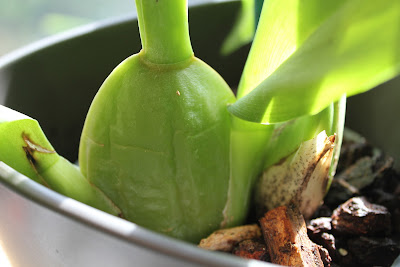
Fig. 6     Cymbidium spike.

The blooming period for cymbidiums is long.  The spikes come out months before the flowers open.  One has to appreciate the beauty of the unopened flowers in order to find joy during the long wait for the flowers to open.  This variety with a droopy spike (Fig. 6) will probably open between April and May.  
 
Fig. 7    Common Blue Violet  (Viola sororia
  Some years ago I planted one, just one, blue violet into a pot. The next year there were several young blue violets around the pot.  Then they were all over the vegetable garden. I like the plant because it is one of the early flowers that bloom in the area during late winter but now the plant is a weed.  I have been removing every single plant that I can find.  This plant (Fig. 7) is a survivor. 

 
Fig. 8     Ornamental Pear tree (Pyrus calleryana 'Bradford') blossoms.

Today my driveway looks as if it is covered with white snow from the falling petals of the flowering pear.  The trees are all white right now but soon green leaves will replace the flowers.

Fig. 9    Purple-leaf flowering plum tree (Prunus cerasifera) blossoms.

These flowers (Fig. 9) remind me of the 'Sakura' or the cherry blossom, a well celebrated flower in Japan. They are beautiful as they bring life and color at the end of the dormant season.  However, they are short-lived. They last for just a couple of days and then they are blown away by the wind.  While they last, one must take the time to enjoy them.  They also remind us that life moves on so that new blossoms will come again.   Japan is hit by an earthquake, tsunami and, heaven forbid, by a nuclear meltdown.  Thousands of lives are lost...but hope is not lost. By God's grace, new beginnings will come to every survivor.

Sometimes plants remind us of our own mortality and sometimes they remind us of our hope for a new beginning.


Thursday, March 10, 2011

My Orange Trees

Fig. 1  Valencia Oranges in the winter. 

While other plants are starting a new season of production, most citrus plants are at the end of a season.   When the garden looks bare and unproductive, the citrus plants remind us that their deciduous counterparts are just taking a break.  They give us a glimpse of summer in a time when the frigid temperatures seem to freeze all possibilites in the garden. 
Fig. 2    First harvest:  Good eating quality, mildly tart, and medium-sized.

 I have two 'Valencia' orange trees that are growing in large pots.  Currently, they are laden with ripe and juicy fruits.  Two weeks ago we harvested some of the fruits in preparation for the supposedly cold snow storm. We did not have the snow but at least the fruits (Fig. 2) got into the kitchen where they are now a regular part of our daily meals.   Soon I will have to harvest them all so that the plant can start another season to produce. 

In my garden I also have a prolific 'Ponderosa' lemon tree where we harvest bags and bags of fruits every winter.   This year I also received a small 'Meyer' lemon tree in a five gallon pot as a present from my mother-in-law.  

Fig. 3    Scale insects on orange fruits.

Last summer these trees were infested with scale insects.   Since the trees are of manageable sizes, I decided to mechanically remove the insects off the branches, patiently.  However, it was battle between me and the ants.   As I demolished colonies of scale insects, the ants literally relocated the "pioneer" scale insects into new territories.  No insecticide was applied.  Some of the branches were severely damaged that I cut them off during the growing season.  The ones that I missed are seen as leafless branches on Fig. 1.  I hoped to win the battle against my wingless enemies (scale insects) the humane or organic way but I lost!   I saw them on the fruits (Fig. 3).  Those black dots on the rind are scale insects.    Somehow, I fear that even after harvesting all of the fruits, some ants somewhere will protecting another "pioneer" to settle on the next spring leaves.
Fig. 4  Limited growing space require regular pruning of plant.

Soon, I will have to harvest ALL the fruits in order to relieve the tree from these demanding "sink".   In a plant the sink is the destination of synthesized food substances from the source which is the leaves.  In families, the young kids can be paralleled to a sink and the parents are the source. :)  

The tree will need to be replenished with all the lost nutrients soon.  Fertilization is more important in potted plants than their in-ground counterparts since there is a limited hunting area for the roots. 

Pruning will also be necessary to remove as much of the damaged branches as possible.   Since the trees also serve as ornamental plants, they will have to be trimmed and cut back to maintain a shape and size that is suitable for the limited space on that side of the yard (Fig. 4). 

"A man ought to carry himself in the world as an orange tree would if it could walk up and down in the garden, swinging perfume from every little censer it holds up to the air."
~Henry Ward Beeher

Tuesday, March 8, 2011

Red Intuition

Fig. 1    Rosa 'Delstriro'  is marketed as 'Red Intuition'

My husband bought me a bunch of beautiful striped red roses last week. The florist at Costco (according to him) was so delighted to inform him that the rose is called 'Red Intuition' and that the other stores do not have them.  With that my curiosity was awakened. 

This is what I found out about the rose 'Red Intuition'.  The registered or official variety name is 'Delstriro' [1].  'Delstriro' is supposed to have resulted from a mutation of the 'Delego' rose variety [1] as discovered by Guy Delbard in 1999.  What a beautiful mutant!   'Red Intuition' is a trademark (marketing name) owned by Delbard, a French company that specializes in breeding work on roses and fruit trees. 

Fig. 2     Perferctly arranged flowers on long stems.

The flowers are beautiful with perfect: double cardinal red petals that are gracefully arranged on long stems.   The feature that makes the flowers distinctly unique is the dark-red-on-red striped petals (Fig. 2) and their large head size.

This particular variety is well known for its superb performance under greenhouse cultivation.  It also responds positively to 'forcing'.   Forcing is the process by which a plant is manipulated to bloom out of season.  This means that 'Delstriro' can be forced to bloom to coincide with the time when red roses are in great demand as in Valentine's Day.  This is a dream variety for flower growers and florists.
 
'Red Intuition' was named the "International Cut Flower of the Year 2000" [2].  It was my personal observation that the flowers remained beautiful and upright for more than a week, probably ten days or so. That is a very long shelf life knowing that they probably came all the way from Colombia or Ecuador and spent some days in a refrigerated room somewhere before my husband purchased them.   

There you have it.  'Delstriro', a rose that mutated from its original traits as 'Delego' [3] into a different but desirable rose.  With its trade name 'Red Intuition', Delstriro (along with 'Pink Intuition' a.k.a Delstripink) has become the choice flower among Hollywood consumers [4].

'Red Intuition' is 'Delstriro' rose.

Saturday, March 5, 2011

Starting Life All over Again

 Fig. 1  A new plant from a leaf cutting.  African Violet (Saintpualia spp.)

Regeneration is the natural process by which some plants or plant-parts replace and restore separated parts to resume a complete plant again. When this phenomenon is applied for the purpose of multiplying the number of plants without the use of seeds, the process is called cloning or vegetative propagation.  The resulting new plant is called a clone.   A clone is a regenerated plant (Fig. 1).  A plant part - such as root, stem, or leaf, can be manipulated into forming new plants by severing it from the mother-plant.  

Most gardeners must have seen or grown an African Violet as a houseplant.  African violet is a good example of a plant that can be cloned easily. To own one plant means that you have a mother-plant that can give you many new plants.  

Fig. 2   Leaves harvested from a mother-plant.

The following pictures demonstrate some of the events that happen during the process of regeneration.  

Fig. 3   Callus formation and Root Differentiation

Callus Formation.  Plant parts such as leaves, when forcibly detached from the mother plant, undergo stress.  The natural response for such plant parts (just like in other life forms) is to start healing.   The first step in the healing process is the formation of soft protective tissue, known as callus, to cover the cut or wound.  Callus is characterized by a thickened outer tissue which is brought about by the rapid formation of undifferentiated mass of cells.  In Fig. 3, the brown colored end of the petioles is the callus.

Fig. 4    The roots are identified from the callus by shape, direction of growth and color. 

Root Differentiation.  The initial purpose of the callus is to form a protective surface over the wound to prevent further damage to the leaf.   As long as the conditions are favorable, cells continue to grow even after the wound has healed.   The leaf that was once a part of a plant will now start its own.  Cells begin to respond to chemical, hormonal, and physical factors which trigger differentiation.   Differentiation is the process wherein new cells take on new and identifiable form and role.  When the wound that triggered callus formation is  completely healed new events begin to happen.   Instead of continuing to grow and clump with the callus, new cells begin to be different.  Fig. 3 and Fig. 4 show roots forming from the callus.  The first sign of new life from the leaf has begun.  However, an old leaf with roots does not make a plant.  Something still has to happen.

Fig.  5   Shoot differentiation above the roots.  

Shoot differentiation.   Cells continue to multiply as shown by the increased root mass (Fig. 5).  The leaf (that was detached from a mother-plant) advances further to regenerate into a complete functioning plant.  The wound and the area around it is now the center of various physiological activities.  Not only have cells differentiated into roots but some begin to differentiate into shoot around the girth of the petiole just above the roots (Fig.5).  The shoots which are the part of the plant that will eventually bear the leaves and flowers have emerged.  


Fig. 6.  Trichome-covered  shoots emerging around the girth of the petiole.  

Note that differentiated tissues immediately assume the appearance of the organ.  The shoot buds contrast with the roots by the following characteristics:  presence of trichomes; green coloring which indicates the presence of chlorophyll; the form; and location and direction of growth (Fig. 6).   Cells that differentiate into roots tend to grow towards the ground and those that differentiate into shoots grow upwards.   Differentiation can be paralleled to the sorting of citizens into their political inclinations - some will be Republicans while others will be Democrats.  Regardless of the direction and position of growth, all plant parts play a key role in the overall functioning of the plant. 

Fig. 7    Root hairs growing from the initial roots.
Steps in Cloning African Violets through Leaf Cuttings1.  Take leaves from the outer ring of the foliage.  Make sure to include part the petiole.  Leaf blades can be used - new plants grow from the midrib, however, the petiole, when cut diagonally, provides a greater surface are for more shoots to grow.
2.  Fill up a pots with sand, perlite or potting soil.  Potting soil and recycled plastic containers can also be used as seen in Fig. 2.  Water until just moist and not soggy.
3.  Lay the leaves with the cut surface touching the media  (Fig. 2).  Cover the pot to prevent fast water loss.
4.  Maintain soil moisture.
5.  Wait and observe till plants develop and ready to be transplanted. 
Fig. 8    New plants - clones of the mother plant

Plants are super-organisms.  Given the right environment most plant tissues can regenerate into new plants.  

Saturday, February 19, 2011

Cymbidium: Factors Contributing to Improved Blooming

The flowers beginning to open.

This green cymbidium which I called Cymbidium California 'Sun Acres' is blooming like crazy right now.  There are five spikes arising from one plant; each spike bearing at least 12 to 16 flowers.  Compared to last year when the same plant showed only one spike with seven flowers, this year's flower yield is dramatically more.  The difference in the vigor of the plant could be attributed to the following factors:

1.  Age.  The plant has grown more since last year.  In orchids shoots and pseudo-bulbs result in more flower spikes.

2.  Fertilizer.  Complete fertilizer was applied twice during the growing season.   This orchid is responsive to fertilization both in terms of growth (shoots) and flowering (spikes).

3.  Light.  The plant has been placed in an area (south-facing) where it was getting sunlight as opposed to the previous year when (because of my lack of know-how) I kept the cymbidiums in the most shady part of the garden.

4.  Orchid mix and Room to grow.  The plant was transferred into a bigger pot with new and fresh orchid mix that I formulated. The formula seemed to work and the increased pot sizes probably increased root growth. 

4.  Differential temperature.  This is the difference between the maximum (day) temperature and the minimum (night) temperature that the plant is exposed to.  Flower initiation in cymbidium is mostly a function of differential temperature. Depending on variety or species, 10-20 degree-difference is required before flower initiation begins.  The current southern-exposure location provided a longer time for the plant to be exposed to a sharper differential temperature.  One reason why cymbidiums kept indoors do not bloom is that the growing temperatures are kept almost constant. 

5.  Visibility and Proximity.  As they say, "out of sight out of mind", plants that are not seen often tend to be less cared for. The cymbidiums were moved into an area next to the back door where I could see them while doing the dishes.  Seeing them reminds me more often to attend to their needs (water and fertilizer).  Although the plant is tolerant to some degree of harsh growing conditions, it responds positively when environmental stresses are alleviated before they reach critical stage.  


Cymbidium is an outdoor orchid; for optimum flowering, treat it as an outdoor plant.  


Monday, February 14, 2011

Cloning Echeveria 'Black Prince'

Echeveria 'Black Prince'
 
Triangular leaves.
 Echeveria 'Black Prince' is a slow and low growing succulent with reddish-brown leaves in triangular shapes.  It has a color that provides a great contrast with the more common greyish-green succulent species.  Althought the plant is apparently dark, the center is green and darkening towards the outer end.  The plant remains compact with very tight internodes.  The plant grows into a rosette - a plant that resembles the structure of a rose flower.  It remains short but it rises up to two-feet high when bolting occurs.   (Bolting is a flowering characteristic of some plants wherein a hormone-induced spike elongates way above the main plant.)

Echeveria 'Black Prince' is a hybrid that resulted from crossing Echeveria shaviana (as the female parent) and Echeveria affinis (the male parent).   E. shaviana has a dainty spreading appearance; the pinkish-grey leaves exhibiting a ruffled look.  E. affinis, on the other hand, has very disciplined look with vertically inclined pointed black leaves.  The 'Black Prince' cultivar got its appealing characteristics from these parents contrasting parents.

Five Steps for Propagating Echeveria 'Black Prince'
This slow-growing succulent can be rapidly cloned by using the right vegetative part of the plant.  I experimented using different leaves from the plant and I was amazed to see the sharp difference in the number of days to root.
1.  Collect plant material.  Collect leaves from the flower spike.  It has been my personal observation that the leaves that are located right below the flowers are easier to root than the leaves coming from the base of the plant.  It could be that the hormone that induced the plant to go into bolting (probably auxin) is abundant in this part of the plant.  Auxin which is a growth regulator that is known to increase shoot and root growth.

Leaves on the spikes are best for propagating.
2.  Heal the cut.  Allow the cut ends of the leaves to heal or develop a callus. This is done by wrapping them with a paper towel and keeping them protected and dry for three to seven days.
Moistened paper towel provides regulated moisture.
3.  Pre-root.  Moisten a paper towel then fold it to fit into the bottom of a small plastic cup.  Then arrange the leaves so that the healed ends are touching the damp paper towel.   Cover with a plastic wrap and leave it alone for a week. (The leaves can be directly planted in small pots but I prefer to get the roots started first.)  This is a good way to maintain the right amount of moisture for optimum rooting. 

Roots growing from the leaves of Echeveria 'Black Prince'.
4.   Grow.  Grow the pre-rooted leaves in a medium that provides needed nutrition for new plants   Succulents generally prefer good-draining (high percentage of sand) potting mix.   Make shallow holes in the adequately watered mix to minimize damage to the roots.  Cover the rooted-end of the leaves with about a centimeter of the mix.
 
Shallow holes.
Cover the rooted ends with a thin layer of potting mix (about 1 cm).
5.   Cover with plastic.  At this point your main adversary to success is too dry or too wet soil.  Dry condition will be delay the growth of new plants while wet condition will induce rotting.  To ensure high percentage of survival, securely cover the trays with plastic wrap.  This will maintain the desired soil moisture during the critical time of rooting until the plant is established.   Keep it in a place with adequate light (I keep them outdoors).  New plants will become visible after two to three weeks.

Trays covered with plastic-wrap.
Clone your Echeveria today; and give them away as gifts.

Tuesday, February 1, 2011

Oncidium

 
Fig. 1    Oncidium (Colmanara Wildcat 'Bobcat')


 A friend of mine gave me an Oncidium orchid last Christmas. Although there are hundreds of species and hybrids under this category of orchids, the one I got is called Colmanara Wildcat 'Bobcat'. The plant came already blooming and more than a month later today, the flowers are still there. The glossy burgundy petals edged around the far end with a touch of gold (Fig. 1) continue to provide a colorful crown to the green leaves. This orchid is commonly seen in many stores in the country but I will introduce it here by featuring some of its attributes that are not so obvious to the eye.

Fig. 2    Oncidiums have column wings

Distinguishing Characteristics. Oncidium is a genus in the orchidaceae family. It is known to be a native of the South America and the Caribbean. It was a Swedish botanist and taxonomist, Olof Peter Swartz [1] who brought this genus to the attention of world. There are hundreds of species and hybrids that are now classified as Oncidium. Nowadays, we would know that an orchid is an Oncidium by the following characteristics:

1. They have column wings
2. The presence of a callus or a tissue growth on the interior side of the lip
3. The formation of pseudobulbs with 1-3 leaves
4. The growth of bracts at the base of pseudobulbs

Hybridization material. Oncidium is one of the most widely utilized orchids for hybridization.  Hybridization is the process of combining desirable characteristics from two genetically different plants into one offspring-plant by way of cross pollination. For example, plant A may have beautiful flowers but blooms only once a year. On the other hand, Plant B may not be so beautiful but it blooms repeatedly during the year. Plant A and Plant B would then be crossed (through hybridization) to combine their desirable attributes (beauty and multiple blooming times) into one plant. That is hybridization in simple terms - but to come up with the ideal hybrid is a long process. Offspring from the same parents exhibit genetic diversity. Out of hundreds or thousands of seeds that result from one cross (Plant A x Plant B) it would be very fortunate to find just the right plant immediately. There are undesirable characteristics of each parent that get transmitted to the offspring, of course. Breeding is long process of cross pollination (of ideal parents) and selection (from resulting offspring) but when the right combination is reached, the reward is worth all the time and effort. Hybridization is achieved by controlled pollination. Most hybrids are interspecific (cross between two species from the same genus) or intervarietal (cross between two varieties/hybrids of the same species which may have resulted from earlier a crosses). In the case of the Colmanara Wildcat 'Bobcat', the plant is the offspring of two other hybrids of different genera (singular -genus): Odontonia (Miltonia x Odontoglossum) and Odontocidium (Oncidium x Odontoglossum). This makes the Colmanara Wildcat an intergeneric hybrid.

Intergeneric hybrid is an uncommon type because it is developed by crossing two plants of different genera. To explain this let me use the example of a more common genus - Solanum. Solanum is a group of plants that are considered nightshade. Among the plants under this genus are tomatoes, eggplant, potatoes, etc. Intergeneric hybridization would involve crossing two different plants from this genus; eggplant x tomato or tomato x potato; it does not happen easily.  So you get the idea; intergeneric hybridization is a challenging process.  On the contrary, it is a common knowledge that interspecific hybridization is the easiest way to find compatibility in parent materials. Going back to orchids, the fact that intergeneric hybridization is possible or even common could reflect some degree of error in classification systems rather than a successful betrayal of genetic boundaries.  It is for that reason that there is a wide variety of Oncidium intergeneric hybrids [2] in the market today.

 
Fig. 3    Callous on labellum and winged-column

Pseudoantagonism.  Most pollinators visit a flower in search of something that they desire such as food or even a mate. Plants on the other hand are often designed to attract their pollinators using scent, color and sometimes reward them with nectar. Some plants do not have anything to offer - so they rely on deceiving the pollinators; this is called deceptive pollination. Oncidium attracts its natural pollinator, the Centris bee, by simulating the apprearance of an enemy-insect. Natural pollination happens by way of pseudoantagonism. In this case the pollinator-bee is deceived into thinking that the flower (because of its shape) is a threat; it attacks the enemy in an attempt to defend its territory. When the bee strikes the enemy a.k.a. flower, the pollinia erupts and the pollens adhere to the attacker. The pollens get carried to the next flower during the next attack. If you use your imagination you can also recognize this insect-like structure on the column which is the center of the flower (Fig. 3). This is a unique and weird pollination mechanism but this is just one of the wonderful mysteries of plant life. 

 
Fig. 4   Pseudobulb with one to three leaves

The bracts that originate from the basal sides of the pseudobulbs are the ones that bear the spikes.

Fig. 5     Bracts growing at the base of pseudobulb.

The next time you go to the store,  try to see if you can identify the Oncidium from the rest of the orchids. 

References:
Related Posts with Thumbnails