Saturday, August 7, 2010

One More Reason Why Tomatoes Should be Harvested...

Birds have decided to help themselves to my tomatoes.

Just because we still have a basketful of tomatoes in the kitchen does not mean that I should stop harvesting them.  Some of my garden friends - the birds, are more than willing to help themselves to the fruits as soon as they see the color turns appetizing. 

 
Birds like to eat the fruits on the upper portion of the tomato plant.

I would have preferred that they eat from the cherry tomatoes. Since they don't eat much, the marble-sized tomato would be a perfect portion for one meal.  But no!  The bigger fruits provide them a place to brace up as they savor the delicious fruits of the garden.  Well, I don't blame them; in fact I need to be generous.   After all they are my partners when it comes to attacking our pesky enemies.  These are the same birds that helped me get rid of the tomato caterpillars from my plants when I was busy doing other things.  If you have not watched a Blue Jay kill a huge caterpillar by hitting it against a rock, then you have not seen much!  :)

Friday, August 6, 2010

Unexpectedly Heavy

Peaches

A week from now these fruits will probably be ready for harvest.  However, as they continue to ripen not only do they get sweeter - they also get heavier and bigger putting more weight on the branches.
Something is wrong with this picture: Too many fruits/branch

This peach tree was heavily infected with peach leaf curl in the spring.  The infection was prolonged due to frequent rains and low temperatures that I did not expect the fruits to remain.  Hence, I did not see the need for any fruit thinning at the time. 

No wonder fruit thinning is such an important operation in the production of quality fruits.  It also prevents damages to the tree.

Big loss

One of the major branches of my tree broke off; it could not hold the increasing weight of the fruits anymore.   It is the fault of the gardener who did not pay attention to the happenings in one corner of the yard.  Knowing how sweet these fruits, my heart sank when I saw this fallen branch.   On the other hand, this is good for the remaining fruits.  They get a better chance to bulk more. 
 Sometimes less is better. 

Thursday, August 5, 2010

Angel's Trumpet: For Your Eyes Only

Angel's Trumpet  (Brugmansia spp.)

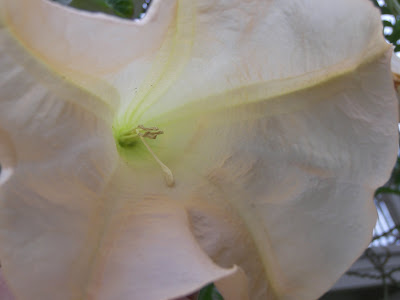
These flowers are gorgeous and they look ethereal.  They come in massive explosions as to cover the whole canopy with trumpet-like flowers.   It is tropical in nature but also grows well in other climatic regions.  These pictures were taken from a tree growing in the coastal town of Goleta, California.  There were several trees planted around the hotel where we stayed.

I'm positive that most if not everyone may have, one way or the other, seen this plant somewhere.  The question is how well do you know the plant?  I am compelled to tell anyone about a danger that lurks behind a beautiful facade. 

The Angel's Trumpet tree (Brugmansia spp.) is a solanaceous perennial.  It can grow as a shrub or a tree depending on pruning style. One characteristic of plants in the solanaceae family (a.k.a. nightshade) is the presence of toxic substance.  The Angel's Trumpet is no exception - in fact all parts of this heavenly-looking tree are poisonous when ingested.   

The blameless-appearance of the flowers veils the poisonous attribute of the plant.

Beautiful trumpet-shaped flowers hang all over the tree.

Angel's Trumpet tree:  Almost 20-ft tall.

Brugmansia spp. makes a beautiful specimen and a dreadful poison in your yard.  Enjoy its looks and educate your garden guests about its vicious characters.

Wednesday, August 4, 2010

Home-grown Onions

Onions (Allium cepa)

Saved from Death.  Last spring I was nonchalantly strolling at Home Depot when I saw bundles of onion seedlings at the clearance shelf.  The seedlings were almost dry with a tiny hint of green at the inner leaves.  I touched them and between my fingers I felt the presence of life.  So for $1.50 per bundle I purchased my right to grant those poor plants a chance to live.  To revive those dry roots I soaked the seedlings in a bucket of water overnight prior to planting.   Since there was no space in my kitchen garden available at that time, I planted them in pots with good friable soil.

Even these onions are interesting to a ten-year old kid.

Raising a Gardener. My little daughter likes helping in the kitchen garden but her attention span is very short when it comes to garden work.   She would be watering the plants in pots that don't get watered automatically and suddenly she'd be gone trying to catch dragonflies.  I'd ask her to weed and before I know she'd be collecting earthworms and naming all of them.   Harvesting these onions in pots appears interesting to her that she remained till she finished harvesting them all.  She complained only once when I asked her to hold the onions for picture taking.  :)  Then she left to go eat some cherry tomatoes on the other side of the garden.

Sweet onions:  Ready for the kitchen

Future Plans.  I have planted onions many times in the past using sets.  This is the first time that I ever used seedlings (almost dead seedlings).  The result is very satisfactory that I intend to start my own seedlings next year.  Starting from seeds is much more economical than buying onion sets.   I will have to remind myself to start germinating them indoors early enough. 

Onions grown in pots.

Try something new in the garden.  It is likely that there is a lesson waiting to be learned.

Tuesday, August 3, 2010

Hort Art: Pollarded Trees at Filoli

London plane trees (Platanus x hispanica) line the entrance to the Filoli visitor center.

Last spring I talked a little bit about pollarding where most of the pictures were taken from the gardens in Paris.  The pictures featured the gnarled and enlarged knobs of the dormant trees.  With my recent visit to the Filoli gardens, I took pictures of pollarded trees - now crowned with green foliage.  

I am really fascinated by the discipline that is involved in pollarding a tree.  A well trained tree is achieved only through the consistency and patience of a gardener.  And although I'd like to adopt pollarding as a pruning technique, it would be a real challenge since it requires special equipment and manpower to do the job.   

The process of pollarding starts with hard pruning.  The major limbs of a tree (not a seedling) is cut back to achieve a desired shape.  However the success of pollarding rests on the annual pruning of the new growths around the cut.  When this is done properly, the process results in the unusual bulging of the underlying stems which makes the trees look interesting.  If the pruning is missed for a year or so, the tree loses its intended shape.

Disciplined shape

Unusually-bulged stems.
Pollarding helps trees maintain the same height and canopy cover through the years.

Pollarding: discipline-instilled on tree and discipline-required from gardener.

Monday, August 2, 2010

Eichornia crassipes

Water Hyacinth (Eichornia crassipes):  Flowers

These beautiful flowers are from a plant that is considered a weed in natural bodies of waters - the water hyacinth.  This is particularly true in California where the plant can withstand the mild winter temperatures.   

Weed is defined as plant growing in the wrong place.  Therefore my plants are NOT weeds because they are growing where I want them to be.  They are floating inside huge decorative pots in my garden.  They help keep the water clear and they produce beautiful ethereal flowers.  

In another place of the yard, we have a plastic pond where my son keeps his pet turtle.  The water hyacinth provides a hiding place for the turtle and adds greenery to an otherwise boring pond.  So it is very useful for us.  The plant reproduces rapidly but I am not worried about it because I am looking at a potential mulching-material.  :)

Water Hyacinth is a free-floating plant.

Grow water hyacinths in your water gardens but don't let them go astray into other waters.

Sunday, August 1, 2010

Joshua Tree

Joshua Tree (Yucca brevifolia)

At the Mojave Desert there is a vast land area where one type of plant stands out taller than the monotonous sea of low-growing shrubs.  This plant is the Yucca brevifolia which is commonly known as the Joshua tree.  The desert sits at an elevation of six to ten thousand feet above sea level which means that it is not only dry but also cold particularly in the winter.  To compare this with our town which is located at 650 feet above sea level; every year one or two of my plants succumb to the freezing temperatures of winter. 

As we traveled through the desert, I wondered how this plant persists in this dry and cold environment.  I understand that the Joshua tree is indigenous to the Mojave Desert and it is not found anywhere else in the world (except where it is cultivated).  What then makes it a plant of this desert?  Here's what I found out to explain this mystery.  This plant in fact develops two types of root systems.  One is a storage root in the form of bulbs (4 feet in circumference) that are buried very deep - 10 to 30 feet into the ground.  This is where water is stored.  The other type is what I call the explorer-roots.  They scout for water on the shallow ground.  Water from rain or melting snow in this desert is often concentrated within the upper layer of the soil. 

The Joshua tree lives on what is necessary instead of optimum.  It maintains the minimum number and size of leaves to reduce moisture lose through transpiration.  It looks whimsical but that's because it grows very slowly; it branches only by the termination of apical growth due to flowering.  It is not there to get big fast but to live and reproduce itself. 

I guess we could learn from the Joshua tree in the way we live.  Avoid excessiveness and learn to live with what's within our means. We could learn to recognize our needs against our desires.   The Joshua tree looks very austere as compared to most trees but it sits on a hefty reservoir of water.

We had to stop to get closer to a Joshua Tree.

The Joshua tree is unique to the Mojave Desert.  Do you know of other plants that are specific to one particular region?  What characteristics do they have that allows them to adapt to that particular area? 
Related Posts with Thumbnails