Thursday, July 8, 2010

Appreciating Detail Through my Camera

Prominent stamens on Spider Plant (Chlorophytum comosum) flowers.

 The details of the Spider-plant flowers are often unappreciated for several reasons.  First of all they are very tiny to appreciate and their color shows no contrast against the leaves of the variegated spider plant ('Variegatum').  With the use of a camera, we can all appreciate these miniature flowers.  The flower is well designed for pollination; the pistil which is the long white structure coming out of the green center (which is the ovary) extends out to the same distance as the stamens which are identified by their yellow color.  No wonder whenever the spider plant is allowed to flower, it reseeds profusely. 

Spider plant is a common houseplant and a very ideal plant for the shady areas outdoors.  It requires low maintenance that it is impossible to kill it.  They have specialized roots that allows them to store water.  That is why it can withstand prolonged periods of dry spells.

Tuesday, July 6, 2010

Beans

Green Beans (Phaseolus vulgaris)

In addition to the vegetables I mentioned last week that are currently growing in my kitchen garden there are also other ones that I seem to have missed - one of them being the green beans.   Beans are very easy to grow but some gardening pests have to be dealt with.  Of the twenty hills that I planted only half of them escaped the ravaging appetite of snails for healthy young plants.  Nevertheless, that did not stop me from trying some more.  When the bush-bean started to flower, I intercropped yard-long beans in between the hills.  When the bush beans will be done producing, I will cut them down to allow more space for the new crop. (Pictures will follow.)

Nitrogen-Fixing.  Beans, just like most leguminous plants, indirectly improve soil fertility.  Legumes are easy to identify - they have seed that are encased in pods.  They are hosts to the nitrogen-fixing soil bacteria called rhizobia.  Rhizobia are different from the rest of the soil microorganisms because they have the ability to fix nitrogen.  They infect the roots of legume plants as indicated by the presence of root nodules.  While they are in the plant they catch nitrogen molecules from the air and transform that into a form that is available for plant use.  Sometimes, gardeners and farmers inoculate the seeds before planting to ensure that nitrogen-fixation occurs. 
Green beans and Basil leaves

 This week we harvested a handful of pods enough to provide the vegetables for one meal.   Inspired by the produce I got from my garden, here's a recipe I made.  You are welcome to try it and modify depending on what's available from your own garden.  

Green Bean/Potato Salad with Left-over steak.  
Ingredients:
1 cup green beans (cooked)
3 small potatoes (boiled and cubed)
10-15 cherry tomatoes (cut in halves)
1/2 cup basil leaves (cut in ribbons)
2 Tbsp Olive oil
1 Tbsp balsamic vinegar
Pepper and salt
Thin slices of cold steak

Method:
Whisk oil and vinegar together. 
Add to the rest of the vegetables and toss. 
 Add salt and pepper according to desired taste. 
Top it with steak.
Enjoy.

Saturday, July 3, 2010

Fourth Of July

Rosa 'Fourth Of July' 
(Parentage:  Rosa 'Roller Coaster' x Rosa 'Altissimo')

Happy Fourth of July everyone!  My family just got back from watching the fireworks at the El Dorado Hills Town Center to celebrate the declaration of independence of this country from Britain.  It was then when democracy was born.  In July 4, 1776 the American flag, known as the red-white-and-blue, flew alone. 
 
Rosa 'Fourth Of July'.  There is a rose named after this eventful day because of its explosion of red/white color.   The flowers are composed of 15-petals with fruity fragrance.  The leaves are glossy dark green that are quite resistant to diseases. This climbing rose was winner of the coveted ARRS award in 1999. 

'Fourth Of July' in my garden.  Although this rose is climbing in nature, the one in my garden is a standard rose - it looks like a tree because of the way it was grafted.  It did very well in full sun but I moved it last year in order to open up a space in the grass area.   Now this rose grows along the southern fence where it gets a lot of the afternoon sun.  It is doing considerably fine but not as vigorous as when it was getting both morning and afternoon sun.  It could also be that it is just taking some time to get re-established in this new place.

'Fourth Of July' rose:  Red and white stripes with yellow center.

Thursday, July 1, 2010

Mango Seedling Emerges

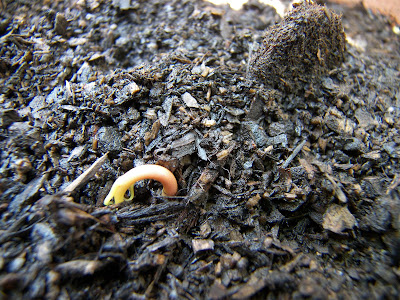
June 28, 2010  - First sign of emergence. 

June 29, 2010 - The plumule is out and starting to unbend.

June 30, 2010 -  The first set of true leaves finds light.

July 1, 2010 - The plumule now turns to a stem as the second set of leaves is beginning to differentiate.

After almost a month since the mango seeds were planted, the first sign of life emerges.   The wait was long considering that the seed was already germinating  when planted.  The radicle which is the part of the seed that would grow downwards to become the main root was visibly elongating.  Yet, it still took almost a month for the plumule (which is the part of the embryo that would grow upward) to find its way into the light.

This seedling has a lot of growing and differentiating to do.  It will be interesting to see how this tropical plant performs in this semi-arid temperate zone.  Although it is not much of a tree, it is the first of its kind that I have seen in California.  

Experiment in your garden and learn something new.

Wednesday, June 30, 2010

"Italian" Caterpillars

Caterpillar feeding on basil

Basil (Ocimum basilicum) is one of the basic aromatic plants that I maintain.  Every summer I grow them in pots near the kitchen.  This is the first year when I had to deal with some caterpillars which were trying to defoliate my basil at a high speed.  I've never had "basil-eating caterpillars" in my garden before.  Could it be that they have migrated from Tuscany? :) 

Phytophagous insects are those that feed on plants.  We see them all the time in our gardens on different plants.  Different insects are attracted to different types of plants.  For example, the tomato hornworm which is the larvae of the Five-Spotted Hawk moth (Manduca quinquemaculata) feeds on tomato leaves as their first choice.  

How do they choose their host plant?  The adult female insect chooses the host plant before they lay their eggs.  The adult insects (moths and butterflies) are beneficial pollinators but their larval form is very destructive to plants.  Although the adult does not have the same diet as the larvae, it knows what its offspring will want to eat.  There are cues that they use to choose their host.  The first one is visual cue - they choose green (plants) instead of brown (soil).  Once they are on the right color location they start to inspect the other details such as the chemical properties of the plants that they have chosen.  Only after they have made sure that the location is right that they begin to check out the other details of the host plant.  The scent, palpability, and taste of the plant will be final test on whether the insect will decide to stay.  Otherwise it will continue to look for another plant until the perfect one is found. 

This is similar to house-hunting.  First we choose the right location or city and then we look for the house that is affordable, with a big yard to garden, or a sparkling swimming pool. We view different houses until we make an offer only on the one that meets our requirements.

The voracious larvae that are on my basil plants did not choose to be there nor did they migrate from another yard because they liked the good smell of the herb.   They were left there by their harmless parents (moth or butterfly) who made sure that their young will be fully supported.

Friends or Enemies?   Well, a couple of days ago I wrote something about saving the pollinators.  Now, I am talking about "future pollinators" eating my food.  How then should we treat them - enemies or allies?  No matter how I will answer this question it will always be wrong.  The butterflies and moths are our partners in food production and they deserve to have food during the different stages of their life cycle.  If we do not want them to feed on our own food then we need to make sure that they can find theirs somewhere.  Therefore, diversify.
  
Plant-eating larvae

Damaged basil plants.

Vegetables in the Garden

Radish (Raphanus sativus)

We have enjoyed a lot of radishes this year.  There are still some left of the 'French-Breakfast' variety in the garden which probably are too hard to eat now.  So far the first sign of bolting has just started.  I am curious to see how big they can get.  For the other variety (round red) bolting has occured a long time ago - in fact pods have already developed. 

Potato (Solanum tuberosum)

There are volunteer-potatoes growing in the vegetable garden.  They are flowering which indicates that they are long-day plants.  The leaves look green and healthy which means that the tubers underneath the ground are getting bigger.  When the leaves start to turn yellow and brown that is the sign that they are about ready for harvesting.

Tomato (Solanum esculentum)

All the tomatoes are doing great.  No diseases and pest so far.   I planted three varieties:  'Better Boy', 'Early Girl', and 'Sweet 100'.  
Yellow Zucchini (Cucurbita pepo)

 These Zucchini are starting to flower although so far no fruit has set.   That is not surprising at all.   Fruits will come; I just have to be patient.

Basil (Ocimum basilicum)

We have a very generous supply of sweet basil this year.  There's a whole plot in the garden and several of them planted in different pots.  That way we can bring some of them close to the kitchen to make cooking more convenient, I guess.

This is just a glimpse of what's going on in the garden at this time.  It will serve as a reference when I make my plans for next year. 

Monday, June 28, 2010

Rosa 'Zephirine Drouhin': Thornless Rose

Rosa 'Zephirine Drouhin': Unopened buds

Rosa 'Zephirine Drouhin': Cerise-pink flowers

The rose 'Zephirine Drouhin' is probably the only rose that would qualify to be planted in front of our house flanking our north-facing garage doors.  When I planted them (three plants) my children were small and played on the driveway a lot.   This rose is thornless and kids are safe around it.  I purchased three of them in Petaluma about eight years ago. 

This old Bourbon rose is overwhelmingly fragrant. It produces clusters of stunning cerise-pink old-fashioned flowers throughout spring, summer, and fall.   An excellent candidate to train on arbors, wall, trellises, or around pillars, it grows vigorously up to 10+ feet tall.   The front of our house gets the sun the later in afternoon and yet this rose is doing just fine.  Therefore, I can say that it can tolerate some shade.  This rose is very responsive to fertilizer.  A little complete fertilizer goes along way with this easy-to-grow and delightful rose.   

The problem I've noted with this rose is its tendency to attract aphids and its susceptibility to powdery mildew.  It is possible that the mildew problem could be less in full-sun growing environment.

Consider having 'Zephirine Drouhin' in your garden.  She will surely delight you.
Related Posts with Thumbnails