Tuesday, February 9, 2010

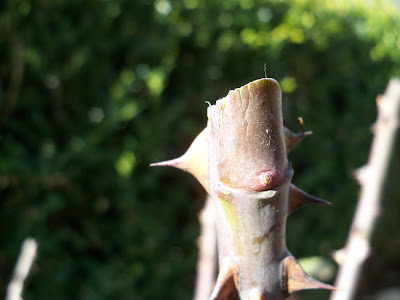
Pruning Roses


As a general rule, I start pruning roses in mid-January till February depending on the variety and the prevailing weather conditions, which can vary from year to year.  Some varieties break dormancy earlier than some.  It is a good idea to start pruning the early ones and finish with he later varieties. 

Last week I started pruning roses in my backyard.  The ones in the front of the house still need to be pruned but since they are mostly climbing roses, pruning is not so critical at this point.

Why prune roses?
As opposed to traditional beliefs, roses are very hardy and forgiving plants.  There are hundreds of rules everywhere on how to prune roses.  For the last fourteen years that I've tended roses in my own garden, this is the one key lesson I've learned about pruning:   The height and angle of the cut, the direction of the bud next to the cut, and even time of pruning does not really matter in the overall growth and performance of the rose. 

Therefore, instead of describing a standard procedure here, I am going to explain the reasons for pruning.  Anybody who understands these reasons will eventually learn how to prune. 
   
1.  To increase plant vigor.  Unproductive canes are dependent on the healthy ones for their maintenance.  Removal of the diseased, small and old (brown instead of green) canes will result in a healthier plant.  Not only will the plant look cleaner but it will also have less chance of infection from the same diseases that infected the previous years' growth.

2.  To increase and prolong flowering period.  Pruning encourages the growth new canes.  Younger canes tend to have a vigorous growth resulting in more branching.  Since flowers appear on new branches, more flowers will be produced.  Eventual pruning, also known as dead-heading, will have the same effect of encouraging further flowering. 

3.  To train the rose to desired shape and direction.   Roses are planted for different purposes.  Some are grown as accent plant, climber, ramblers, or in beds as in botanical gardens.  In general, roses are pruned to have an open vase-shape allowing the canes to grow slightly outward as in the letter V.
Ramblers and climbers are pruned to train and guide the canes to follow a specific direction as is growing to cover an arbor.  Once they are established, pruning will be done to maintain the shape and remove dead and damaged branches.  New canes will grow and if they are not wanted, be ruthless to cut them off.  Some climbers, such as 'Cecile Brunner', are very aggressive that if you allow them to grow without intervention, then you are setting yourself for a mega-pruning job in the future.

General Pruning Tips:
1.  Equip yourself with very sharp pair of shears.  They will make life easy for you and your roses.
2.  Protect yourself with heavy duty gloves to avoid unnecessary cuts and scratches.
3.  Choose the canes that you want to remain.  Consider vigor, position, and age of cane.
4.  Remove all unwanted canes and dead wood. 
5.  Cut the remaining canes to desired height.  For taller roses, prune higher and vice versa.
6.  Remove all old leaves from pruned plants.  This will trick the plant into believing that it has gone through dormancy and now it should start to grow.

Stroll in your garden, it's good for you and your plants.

Wednesday, February 3, 2010

What's in the Label?


What Do Fertilizer Labels Mean?
Commercial fertilizers, by standard, contain at least one of the three primary nutrients (N), phosphorous (P), and potassium (K).  Phosphorous and potassium in their elemental form cannot be absorbed by the plants.  In fertilizers they come in a form that is useable by plants.  Phosphorous comes in the form of phosphate (P2O5) while potassium comes as potash (K2O).  Fertilizer qualifies to be a commercial grade only when it contains more than five percent of N, P2O5 or K2O.

Every bag of commercial fertilizer is labeled with three numbers separated by dashes as shown in the above picture.  These numbers reflect the percentage of the three primary nutrients in the fertilizer, the first number being nitrogen (N) - the second number is phosphate (P2O5) - the third number is % potash (K2O).  The label always lists the nutrients in this order.

16-20-0 is a fertilizer containing 16% nitrogen, 20% phosphate, and 0% potash.  Mixed fertilizers (fertilizers that contain two or more of the primary nutrients) either complete or incomplete, are made by combining different single-element sources to form a desired blend.  Because of this combination, the resulting fertilizer mix may have particles of varying colors.   In as much as plants require different proportions of the primary nutrients, manufacturers produce different grades. 

How to determine the nutrient content of fertilizers
1.  Fertilizer grade (example 6-10-10)
2.  Total weight per bag (example 50 lbs)
3.  To determine the nitrogen (N) content:  50 lbs x 6%
                     50 x .06 = 3 lbs N
4.  To determine the phosphate (P2O5) content:  50 lbs x 10% P2O5/lb fertilizer
                      50 x .10 = 5 lbs phosphate
5.  To determine the potash content:  50 lbs x 10% K2O/lb fertilizer
                     50 x .10 = 5 lbs potash 
6.  The total amount of nutrients in the 50-lb bag of fertilizer is 13 lbs.  The rest is inert filler material.
7.  To convert phosphate into phosphorous and potash into potassium the following conversion rate are necessary:  1 lb of P2O5 = 0.44 lbs P; 1 lb of K2O = 0.83 lbs K.  So, we already know that there are 5 lbs of phosphate and 5 lbs of potash in a 50 lb bag of 6-10-10. 
To convert phosphate in to P:  multiply phosphate weight by 0.44 lbs.
        5 x 0.44 = 2.2 lbs P
To convert 5 lbs potash into K:  multiply potash weight (lb) by 0.83 lb/lb K2O
        5 x 0.83 = 4.15 lbs K

It is important to master this simple math skill because it is a tool in determining the economics of your choice of fertilizer.

Functions of the Three Major Elements

To appreciate and understand the meaning of the fertilizer grades, one must understand the functions of the elements that are featured in the fertilizer labels. 

Nitrogen (N) is the major element that affects vegetative growth of plants.  Sufficient nitrogen results in good foliage which key to producing a good crop.  Nitrogen is a major component of plant proteins, chlorophyll, vitamins, and enzymes.  It is gives the green coloring of the plant.

When nitrogen is deficient, plants exhibit stunted growth, chlorosis or yellowing on older leaves, premature death and poor yields.

Nitrogen is a plant-mobile element, therefore the symptoms of deficiency are observed on the older leaves. 

Phosphorous (P) promotes early root formation and growth.  It is a component of some enzymes and proteins, ATP, RNA and DNA necessary for plant development.  Phosphorous also promotes healthy development of the reproductive system of the plant.  When we say reproductive system we are referring to the flowering, fruit setting and seed development.  

Deficiency on phosphorous is manifested by stunted growth of plants, unusual dark green and purple pigmentation on leaves, poor fruit and seed development, and delayed maturity. 

Unlike nitrogen, phosphorous is an immobile element hence, the deficiency symptoms are usually noticed on the younger plant parts.

Potassium (K) is necessary in the following plant processes:  formations of sugars and carbohydrates; protein synthesis; and cell division.  It is enhances flavor and color on flowers, fruits, and vegetable crops.  It also helps increase fruit size and quality which results in better marketability of produce.  Potassium helps build resistance of plants to diseases. 

Plants that are deficient to potassium exhibit the following symptoms:  slow growth resulting in low yields; scorched or burned appearance on leaves; necrosis on mature leaves; weak stalks resulting in lodging; and small fruits and shriveled (undeveloped) seeds.


Therefore  a fertilizer that has the label 6-10-10 (6% N - 10% P  -10% K) is intended to promote a healthy plant growth giving special emphasis on root and fruit development just like what a gardener would on his tomatoes.  On the other hand, a fertilizer with a label of 21-0-0 (21% N and 0% P and K) is intended to meet the needs of a plant to develop healthy foliage.  It is usually applied on lawns and non flowering and fruiting shrubs.  The fertilizer 16-20-0 is a formula that's used to provide nitrogen and phosphorous needs of plants.  The emphasis here is foliage growth and root and flower formation.  This also can be used in areas where K is needed but the soil has sufficient amount of K2O.

Pointers to Consider Before Choosing your Fertilizer:

1.  Have your soil analyzed. 
Soil analysis result will give you a customized fertilizer recommendation for your garden.  Collect soil samples.  Assign five locations that represent the different sections of your garden.  Collect soil by cutting straight into the soil up to about one foot deep.  Avoid scraping only from the top soil.  Air-dry soil samples.  Mix a you pulverize the samples.  Put them in a bag and send them to a soil analysis lab in your area.

2.  Observe your plants
Observe how your plants grow.  Look for unusual appearance and behavior. (I will remind myself to post a list of the most common deficiency symptoms as reference.) 

3.  Acquaint yourself with general knowledge
The soil in general contains all the essential elements for plant growth.  Some elements are more abundant than some.  Nitrogen, because it is absorbed by plants in large quantities, and can be lost easily through leaching and immobilization, needs to be replaced more regularly than P and K.  Phosphorous is often bound in the soil due to soil unfavorable soil pH (soil acidity).  Water plays an important role in making the elements available for plant uptake. 

4.  Avoid fertilizer overdose
Fertilizers are like medicines.  They are helpful in the right amounts but can be toxic beyond a certain level.  Addition of any element to the soil will result in a change in the soil chemistry.  Sometimes, too much of one thing will bind other element making them unavailable for the plants thereby solving one problem by creating another.  Always follow the recommended rate and procedure of application.

5.  Pricey does not always mean better
Now that you know the meaning of the labels, you should be able to determine which bag gives you the nutrient at the least cost per unit weight.

Thursday, January 28, 2010

Hort Art: Mazes and Labyrinths

I have always been fascinated by hedges maybe because it was a part of my everyday life growing up.  In a little town in the Philippines where I came from, hibiscus were used as fence-plants.  They are planted closely so that they would form a hedge along the roads. 

Then I went to Britain where I saw a completely different application of the hedge.  Hedges are designed geometrically to form mazes and labyrinths.  Although mazes are rooted on myths of long time ago, they maintain a classic appeal to people of all ages.   Today,  they have become part of gardens in many countries of the world.  They are designed for entertainment, recreation, as object of art, object of magic and meditation.  Mazes in the gardens are like living puzzles.   Unlike the labyrinths, mazes have dead end and therefore you can get lost in it...which probably provides more challenge and attraction to the adventurous ones.  Here are three examples of mazes, the ones that I've seen, in Britain.  Notice that the plants used are different. 

The Murray Star Maze at Scone Palace
The Murray Star Maze, was designed by the world renowned Maze designer Adrian Fisher, is Perthshire's only maze. Designed in the shape of the five pointed star that's featured in the Murray family crest. The maze comprises 2000 beech trees, half copper and half green, planted in a way to create a unique tartan effect.  I did not have a good position to take a picture that would show the overall effect of the design.


Jubilee Maze
The Jubilee Maze a.k.a. "The Amaging Hedge Puzzle" is about twenty years old.  It was designed by Lindsay and Edward Heyes.  Edward Heyes does the trimming himself and according to his records it takes him 10 weeks per year to trim the hedges.   The maze is made of 1,039 Port Orford Cedar bushes.   

Maze Garden at Hampton Court
The maze garden at Hampton Court in Herefordshire is made of a thousand yews with a gothic tower at its centre.  In this picture the plants were in the process of being trimmed. 

If you have a land to spare and a dream to have tourists visiting your garden, then plan on adding a maze to your garden.  This will surely amaze your neighbors.  Visit your local professional nurseries not only to see what's available and adapted to your area but also to see if you like the plant.   After you have selected your type of plant then you can browse the internet for a more reasonable price. 

Hedges are live garden structures.  Take time to care and train them.

Monday, January 25, 2010

Hort Art - Hedges


Picture taken at the Royal Botanic Garden Edinburgh

Hedges provide architecture and structure to any garden.  The strong lines that they make provide an anchor for everything else that are added to the garden.   Hedges provide a privacy feature as they can be used as fence and even divide gardens into rooms.

Hedges are shrubs that have been planted closely and allowed to grow into each other's space and trained into a desired shape and size.  Hedges look neat and disciplined but that does not happen without the gardeners intervention.   A good hedge require constant pruning and shaping.  Left alone for a long period of time, hedges will grow on their own way and eventually look wild.  Gardeners need to be ruthless in pruning hedges so that they would maintain their intended shape and size.  My own boxwood  (Buxux microphylla) hedges keep on growing wider and taking too much space into the pathway.  

Commonly Used Evergreen Shrubs for Privacy Hedges:
1.  Japanese Boxwood (Busus microphylla)
2.  Yew (Taxus baccata)
3.  Arborvitae (Thuja occidentalis 'Green Giant')
4.  Holly (Ilex verticillata)
5.  Leyland Cyprus (x Cupressocyparis Leylandii)
6.  Variegated Japanese Laurel (Aucuba japonica ‘Variegata’) aka Gold Dust Tree
7.  Catoneaster (Catoneaster lucidus and Catoneaster divaricatus)
8.  Heavenly Bamboo (Nandina domestica)
9.  Firethorn (Pyacantha coccinea)
10.  Privet (Ligustrum spp.)

Wednesday, January 20, 2010

Hort Art - Living in the Garden


The word horticulture is not something you see on the streets everyday, unless you are in a university where plant sciences are offered.   I was in Spokane when I saw an interesting van.   The artwork on the window is simple and catchy.  But then I wondered how "horticulture meets art" when horticulture is already art in itself?  Could it be that Art is a guy?  If that's the case then she has a beautiful name!  :)

Thursday, January 14, 2010

To Garden or Not...


Commercial Potato Production (The Sunrise Produce Farms)

Just like New Year's resolutions are thought of at the beginning of the year, so gardening plans ought to be also.  You want to loose weight... therefore go ahead and think of the ways that you can achieve that.   So you decide to shorten your hybernation.  While you are panting on the treadmill or sweating your muscles out in the gym you can also be thinking of the things that you want to see in your garden come spring and summer.  Imagine yourself in your skinny form walking in the garden or by the pool.  Well, that picture needs to include some color in the background such as flowers and greenery.  That can be fixed, right?  You might even want to look like a health goddess walking along rows of life-prolonging-herbs and draping with high-in-antioxidant fruits of various forms and fiber content.  Did you say you want organic fruits?  You can certainly produce your own organic you-name-it...but you've got to plant a garden.   You won't loose your excess poundage either is you don't start moving or changing your habits.
Yes, making yourself look beautiful and healthy involves making your surroundings in ship-shape.  Be trendy - eat foods that are grown locally; the closer they are grown to your kitchen, the better.  Even those who are not gardeners can learn to become one.   It may seem daunting at first but gardening is learned and every gardener develops their own style based on knowledge, practice, and attitude.  The following quote says it all:

"The fact is that farming is not a laboratory science, but a science of practice. It would be, I think, a good deal more accurate to call it an art, for it grows not only out of factual knowledge, but out of cultural tradition; it is learned not only by precept but by example, by apprenticeship; and it requires not merely a competent knowledge of its facts and processes, but also a complex set of attitudes, a certain culturally evolved stance, in the face of the unexpected and the unknown. That is to say, it requires style in the highest and richest sense of that term."
"Discipline and Hope,"
A Continuous Harmony: Essays Cultural and Agricultural

  Plant a garden...it's good for you and your environment.

Friday, January 8, 2010

Color Change in Citrus


Fruits on pot-grown oranges (Citrus sinensis)

Tropical Zone.  Citrus fruits like oranges and lemons start out green and remain in that color till maturity.  I remember, having grown up in the tropics, that all the citrus fruits I've seen were green.  When they are mature and harvested their color are still green different only from their immature counterparts by the shine and gloss on the rind.  By the time they turn orange or yellow, they are already over-ripe and cottony and tasteless.  Commercially grown citrus can be treated with ethylene after harvest to induce uniform and timely yellowing for a more appealing look. 

Temperate Zone.  Citrus plants grown in temperate places with mediterrenian-like climate, low temperatures induce a change in color to deep orange or yellow even before the fruits mature.   The color can be deceptive.  It is important to harvest the fruits when they are fully mature, it is when the sugar and the acidity balance is at its best. 


Lemon (Citrus limonia)

Hidden from our eyes are processes that are constantly happening in the plants.  Shifts in these processes are caused by a number of environmental factors.  The green color in unripe citrus plants is a result of the dominant presence of chlorophyll on the rinds.  The yellow or orange color in ripe citrus fruits is a manifestation of the high concentration of carotenoids.  When temperatures go down to a certain critical level, such as in the winter, the rate of chlorophyll production in the plant slows down or completely stops.     Furthermore, the existing chlorophyll undergoes a process of degradation while the biosynthesis of carotenoids increases, particularly in the fruits.

Stroll in your garden... its good for you and your plants.
Related Posts with Thumbnails