Showing posts with label Toxic Plants. Show all posts

Sunday, September 2, 2012

HortiCOOLture - Armored Plant

Fig. 1   The bizarre porcupine tomato (Solanum pyracanthum).


Ornamentally Odd
When all the basic plants are in place in the garden, an oddity here and there is in order.  This week our local nursery is offering a plant that would fit the bill.  The "Porcupine tomato" botanically known as Solanum pyracanthum (Fig. 1) is a plant that is armored with spikes all over. 

In spite of being prickly, some ornamental features can be attributed to this plant.  The bright orange spikes provide a pleasing textural and color contrast against the bluish green velvety leaves (Fig. 2).  The royal purple petals are complemented by protruding yellow stamens in the middle.   Eventually, small cherry-tomato-like fruits will take the place of the colorful flowers. A plant with such attributes definitely makes a statement in any garden.


Fig. 2   Dagger-like spikes on land under leaves of Solanum pyracanthum


Physical and Chemical Threat
This may be an ornamental shrub but the plant is definitely for your eyes only. The velvety green leaves may look soft and friendly but the dagger-like spikes (Fig. 2) that are spread all over the plant  make the plant look utterly foreboding.   I would not recommend this plant near playground areas.  The quills would deter any one from touching the plant but the danger does not end there.  The plant is known to contain various toxic substances on the leaves, stems and fruits - just like most solanaceous (night shade) plants.   Because of this, it is not clear whether the spikes were meant to protect the plant from humans and animals or vice versa. 


Fig. 3  Solanum pyrachantum flower.
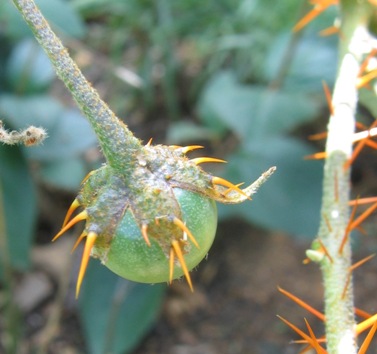
 
porcupine tomato
 Fig. 4   Armored fruit of Solanum pyrachantum. (Photo from Rob's Plants)
 
 
Threat of Invasion
The plant is drought tolerant therefore caution should be observed when it comes to cultivating this plant since it can be invasive depending on the growing conditions.  The fruits are loaded with seeds which when allowed to mature and fall on the ground will result in an explosion of new seedlings.  Eradicating an army of plants like this, would involve a bloody battle.  :)  


 Solanum pyrachantum, although related to food crops like potato, tomato and eggplant, has been cultivated solely as ornamental plant.  And we will keep it that way! 

Monday, January 16, 2012

Brugmansia sanguinea: Toxic Angel

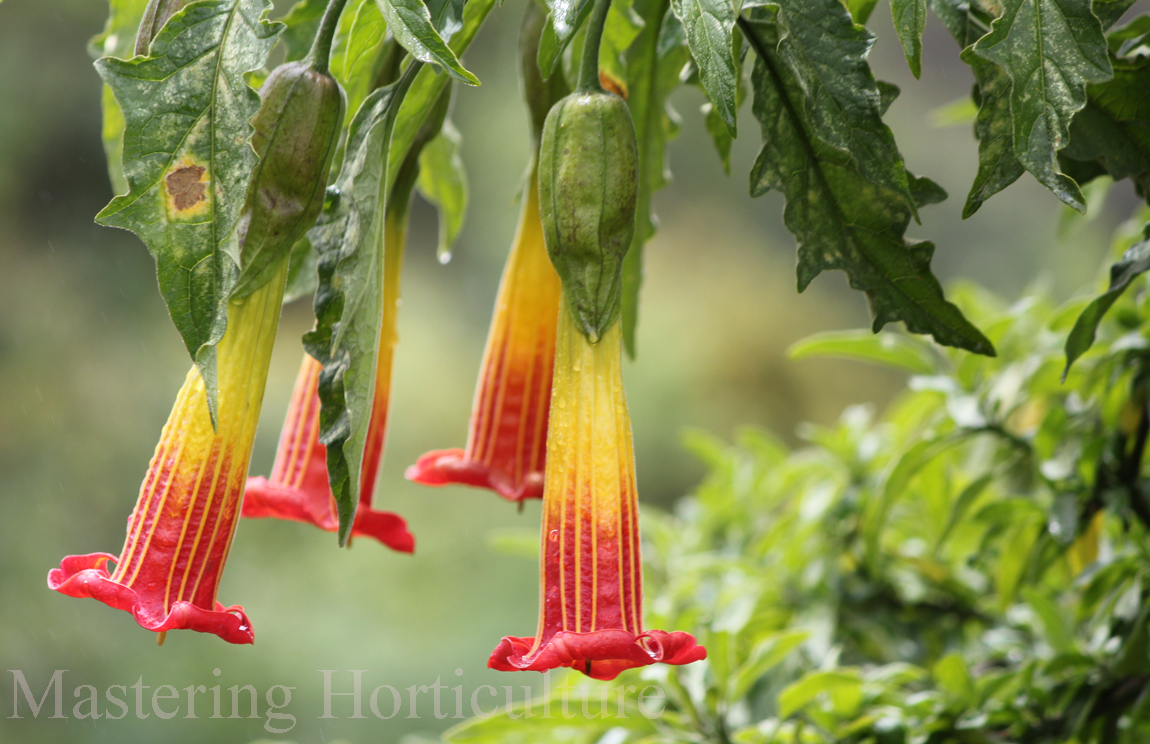
 Fig. 1  Brugmansia sanguinea 'Red Angel's Trumpet' Flower

Last year I got the chance to get really close to another angel's trumpet, the Brugmansia sanguinea.  The term sanguinea which is derived from the Latin word for blood (sanguis) describes the color of the corolla tube.  The color red distinguishes this plant from the species within the genus Brugmansia. 

These are the seven known species of Brugmansia according to the International Brugmansia and Datura Society:  Brugmansia arborea; Brugmansia aurea; Brugmansia insignis; Brugmansia sanguinea; Brugmansia suaveolens; Brugmansia versicolor; and Brugmansia vulcanicola.  They are native to South America along the Andes Mountains from Colombia to Chile. 

 
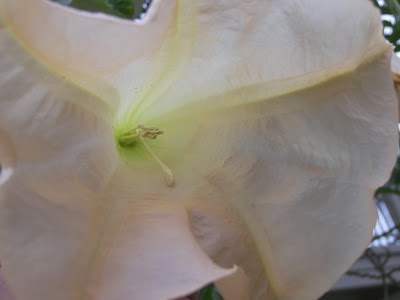
Fig. 2   Brugmansia sanguinea: The Corolla

Native environment. 
The flowers in the pictures here were all taken in Bogota, Colombia.  (My family visited one of the tourist attractions in Bogota - the  Mount Montserrate which can be reached by an aerial tramway or a funicular.) To give you an idea of environment there - Bogota is located somewhere along the equator with an elevation of about 10,300+ ft. above sea level.  The place is in the tropics but it feels like San Francisco, California.  Also, because it is located along the equator, the daylength is always the same throughout the year.  In other words the climate there is unexpectedly and consistently mild. 


Fig, 3    Brugmansia sanguinea - Pendant flowers

 
Fig. 4   Brugmansia sanguinea flowers are used as some sort of offering.

Toxic Angel.  The pendant flowers of the Brugmansia (Angel's Trumpet) are delightfully inviting but never forget that the plant is deadly. I have warned readers about the toxic contents of Brugmansia a while back.  I was shocked (not because of propriety but of safely) to see some pilgrims visiting the church at the top of  Montserrate, pick these flowers from the surrounding gardens and lay them down at the different stations of the cross (Fig.4).

Cursed Devil.   While Brugmansia is considered an angel (as in Angel's trumpet), she has a cousin who has fallen into the dark side.  Datura, aka Devil's Trumpet, is so closely related to Brugmansia that formerly they were classified under the same genus. That has changed.

These two relatives can be identified from each  other, firstly, by the position of their flowers.  Angel's trumpet hangs like pendant looking down to earth (Fig. 1) while Devil's Trumpet, looks up to the heavens as if asking forgiveness.  As the story goes, the devil was once an angel himself.  Secondly, Brugmansia is a woody plant (in a tree) while Datura is often an annual (herbaceous) and sometimes, depending on species and growing conditions,  a short-lived perennial.
It is well established that Datura, just like Brugmansia, is highly poisonous.  Careful handling of this plant is highly recommended. 

At 10,300+ ft elevation, Mount Montserrate has a tropical yet mild climate.

I've heard a European shepherd once say that it is alright to have wolves around his flock as long as he sees the wolves first before they see him.  The problem is when the wolves see him first - then it is too late.  Likewise, it better to know the dangers Brugmansia has before it tells you so.   

Thursday, August 5, 2010

Angel's Trumpet: For Your Eyes Only

Angel's Trumpet  (Brugmansia spp.)

These flowers are gorgeous and they look ethereal.  They come in massive explosions as to cover the whole canopy with trumpet-like flowers.   It is tropical in nature but also grows well in other climatic regions.  These pictures were taken from a tree growing in the coastal town of Goleta, California.  There were several trees planted around the hotel where we stayed.

I'm positive that most if not everyone may have, one way or the other, seen this plant somewhere.  The question is how well do you know the plant?  I am compelled to tell anyone about a danger that lurks behind a beautiful facade. 

The Angel's Trumpet tree (Brugmansia spp.) is a solanaceous perennial.  It can grow as a shrub or a tree depending on pruning style. One characteristic of plants in the solanaceae family (a.k.a. nightshade) is the presence of toxic substance.  The Angel's Trumpet is no exception - in fact all parts of this heavenly-looking tree are poisonous when ingested.   

The blameless-appearance of the flowers veils the poisonous attribute of the plant.

Beautiful trumpet-shaped flowers hang all over the tree.

Angel's Trumpet tree:  Almost 20-ft tall.

Brugmansia spp. makes a beautiful specimen and a dreadful poison in your yard.  Enjoy its looks and educate your garden guests about its vicious characters.

Saturday, July 24, 2010

Handle with Care: African Fire Sticks

African Fire Sticks (Euphorbia tirucalli)  Photo from Wikipedia
Common Names: African Fire Sticks, Pencil Tree, Milk Bush
  
 The plant Euphorbia tirucalli recently sent Pastor Rick Warren to the emergency room.  Read the article that describes what happened.  If you happen to have this in your garden or will come close to this plant in the future - be informed that this plant can be dangerous if it is made to "bleed". 

Inside the stick-like branches is corrosive and extremely toxic milky sap.  It can cause severe pain and detrimental effects on the skin and eyes on contact and fatal when ingested.  I would say that this is not safe to have around children.  If you really want to have it in your garden, take extra precaution when handling it.

Beauty is deceptive.  Get to know the plants in your garden.
Related Posts with Thumbnails