Showing posts with label Epiphytes. Show all posts

Tuesday, February 1, 2011

Oncidium

 
Fig. 1    Oncidium (Colmanara Wildcat 'Bobcat')


 A friend of mine gave me an Oncidium orchid last Christmas. Although there are hundreds of species and hybrids under this category of orchids, the one I got is called Colmanara Wildcat 'Bobcat'. The plant came already blooming and more than a month later today, the flowers are still there. The glossy burgundy petals edged around the far end with a touch of gold (Fig. 1) continue to provide a colorful crown to the green leaves. This orchid is commonly seen in many stores in the country but I will introduce it here by featuring some of its attributes that are not so obvious to the eye.

Fig. 2    Oncidiums have column wings

Distinguishing Characteristics. Oncidium is a genus in the orchidaceae family. It is known to be a native of the South America and the Caribbean. It was a Swedish botanist and taxonomist, Olof Peter Swartz [1] who brought this genus to the attention of world. There are hundreds of species and hybrids that are now classified as Oncidium. Nowadays, we would know that an orchid is an Oncidium by the following characteristics:

1. They have column wings
2. The presence of a callus or a tissue growth on the interior side of the lip
3. The formation of pseudobulbs with 1-3 leaves
4. The growth of bracts at the base of pseudobulbs

Hybridization material. Oncidium is one of the most widely utilized orchids for hybridization.  Hybridization is the process of combining desirable characteristics from two genetically different plants into one offspring-plant by way of cross pollination. For example, plant A may have beautiful flowers but blooms only once a year. On the other hand, Plant B may not be so beautiful but it blooms repeatedly during the year. Plant A and Plant B would then be crossed (through hybridization) to combine their desirable attributes (beauty and multiple blooming times) into one plant. That is hybridization in simple terms - but to come up with the ideal hybrid is a long process. Offspring from the same parents exhibit genetic diversity. Out of hundreds or thousands of seeds that result from one cross (Plant A x Plant B) it would be very fortunate to find just the right plant immediately. There are undesirable characteristics of each parent that get transmitted to the offspring, of course. Breeding is long process of cross pollination (of ideal parents) and selection (from resulting offspring) but when the right combination is reached, the reward is worth all the time and effort. Hybridization is achieved by controlled pollination. Most hybrids are interspecific (cross between two species from the same genus) or intervarietal (cross between two varieties/hybrids of the same species which may have resulted from earlier a crosses). In the case of the Colmanara Wildcat 'Bobcat', the plant is the offspring of two other hybrids of different genera (singular -genus): Odontonia (Miltonia x Odontoglossum) and Odontocidium (Oncidium x Odontoglossum). This makes the Colmanara Wildcat an intergeneric hybrid.

Intergeneric hybrid is an uncommon type because it is developed by crossing two plants of different genera. To explain this let me use the example of a more common genus - Solanum. Solanum is a group of plants that are considered nightshade. Among the plants under this genus are tomatoes, eggplant, potatoes, etc. Intergeneric hybridization would involve crossing two different plants from this genus; eggplant x tomato or tomato x potato; it does not happen easily.  So you get the idea; intergeneric hybridization is a challenging process.  On the contrary, it is a common knowledge that interspecific hybridization is the easiest way to find compatibility in parent materials. Going back to orchids, the fact that intergeneric hybridization is possible or even common could reflect some degree of error in classification systems rather than a successful betrayal of genetic boundaries.  It is for that reason that there is a wide variety of Oncidium intergeneric hybrids [2] in the market today.

 
Fig. 3    Callous on labellum and winged-column

Pseudoantagonism.  Most pollinators visit a flower in search of something that they desire such as food or even a mate. Plants on the other hand are often designed to attract their pollinators using scent, color and sometimes reward them with nectar. Some plants do not have anything to offer - so they rely on deceiving the pollinators; this is called deceptive pollination. Oncidium attracts its natural pollinator, the Centris bee, by simulating the apprearance of an enemy-insect. Natural pollination happens by way of pseudoantagonism. In this case the pollinator-bee is deceived into thinking that the flower (because of its shape) is a threat; it attacks the enemy in an attempt to defend its territory. When the bee strikes the enemy a.k.a. flower, the pollinia erupts and the pollens adhere to the attacker. The pollens get carried to the next flower during the next attack. If you use your imagination you can also recognize this insect-like structure on the column which is the center of the flower (Fig. 3). This is a unique and weird pollination mechanism but this is just one of the wonderful mysteries of plant life. 

 
Fig. 4   Pseudobulb with one to three leaves

The bracts that originate from the basal sides of the pseudobulbs are the ones that bear the spikes.
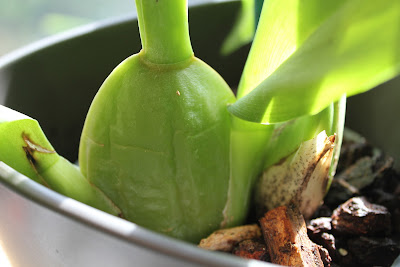
Fig. 5     Bracts growing at the base of pseudobulb.

The next time you go to the store,  try to see if you can identify the Oncidium from the rest of the orchids. 

References:

Friday, December 10, 2010

Schlumbergera

Schlumbergera truncata in bloom.

History. The Schlumbergera is a rainforest-cactus that originated from Brazil.  In Brazil, it is called Flor de Maio because it blooms from April to July, May being the peak of its beauty.  In fact it is a popular Mother's Day flower.   It was named, later on, after Frédéric Schlumberger (1823-1893), a Frenchman, who was a collector of cacti and other succulents (1).  The name "Thanksgiving or Christmas Cactus" was only part of a marketing strategy.  On this part of the globe (northern hemisphere), this plant happens to bloom during this time of the year.  Flowering period coincides with Thanksgiving and Christmas seasons depending on variety. 

Origin.  To be specific, Schlumbergera is known to have come from the tropical rainforest north of Rio de Janeiro. They are epiphytes which mean that they grow on the canopies of trees. Perched up above and on rocks under the shade of taller vegetation, they are adapted to dry conditions and attenuated light.

Photoperiodism.   As I have mentioned many times in previous posts, flower initiation in most plants is triggered by daylength or photoperiod.   Schlumbergera is a photoperiod-sensitive plant.   In my garden, it is regarded as an outdoor plant.  It has been my observation that flower initiation begins sometime in October when daylength is between 9 and 10 hours, therefore they are considered short-day plants (flowering when exposed to daylengths that are shorted than 12 hours).   

Schlumbergera can be manipulated to flower earlier or later by changing the length of light and dark period in a day (24-hour).  Short days can be simulated by subjecting the plants in a prolonged darkness (about 15 hours per day) for a period of one month.  Flowering can also be delayed by reversing the treatment - extend the days by providing few hours of artificial light before sunrise or after sunset.   When the flower buds begin to show, the plants can be brought out to normal conditions.    Artificially inducing the plants to flower is being practiced by commercial growers in order to coincide blooming with the best selling period.  

Flower buds appear on the far end of the stems.

Leaflessness.  These cacti do not have leaves.  Instead they have phylloclades.  Phylloclades are modified branches characterized by being flat and the ability to photosynthesize.  Although they are not leaves they perform the role of leaves for the plant.  Unlike true leaves, phylloclades do not fall (abscise) off with age; instead they turn woody and brownish because a new generation of phylloclades grow from the older ones (just like a lateral branch grow from a more mature branch).  In the absence of leaves, plants do not wilt.  Prolonged exposure to water stress result in shriveling of the plant which is preceded by observed lightening of the green coloration.   Flowers are borne on the apical end of the phylloclades.  

 Soft serration on the phylloclades: characteristic of the Thanksgiving cactus. 

 The perianth at an early stage (sepals, petals, and the tube).

The perianth at opening. 

Reflexed petals.

Observations on the Flowers.  The petals reflex (bend backwards at an acute angle) further exposing the stamens and the anthers.   One peculiar thing that I noticed is that the petals right above the reproductive parts did not reflex upwards.  This tendency of the plant could be nature's way to keep the pollens dry - an adaptation mechanism that is necessary for rainforest plants such as the Schlumbergera species.

Picture taken behind the petals to emphasize the perianth tube.

The stigma prior to opening has an ovoid shape...

 androecium (male parts) and gynoecium (female part)

The stigma extends past the length of the stamens - opening into a claw-like shape.   This is an important feature considering that the flower droops down at opening.  In this position the pollens conveniently falls into the sticky stigma - allowing successful pollination.

The stamens are fused to the perianth tube.

When I opened one of the flowers it came to my attention that the stamens are fused to the perianth tube.  In the more common flowers (take the rose for example), the petals are not attached to either the androecium not the gynoecium.    

Inside the perianth tube.

The flowers are very shimmery. 

Schlumbergera, an epiphyte that has a precise sense of timing... 
She models her bold and shimmery flowers when her rivals are still asleep.
_______________________________

Sunday, December 5, 2010

Understanding the Epiphytic Orchid

Orchids I saw at the gardens of the  Intercontinental Hotel (Makati).

The Mediterranean climate here in California allows us to grow a wide variety of exotic plants.  However, with my recent trip to the Philippines, envy crept all over me and my humanity gave in when I saw the way orchids are growing there.  I can grow them here but it would not be as easy as when they are grown in their native habitat.   Here we enjoy the dryness of the Mediterranean air and despise the humidity of the tropical breeze.  However, we know that the epiphytic-orchids feel the other way around.
 
The Greenbelt Shopping Center boasts beautiful orchids that are planted between buildings.

Epiphytes.  Epiphytic plants (roots are above ground) like most orchids derive nutrients and water from the atmospheric air.   Orchids growing on tree trunks are a common sight in wooded areas of the Philippines as well as in home gardens and as well as in public gardens.  Gardeners bring these beautiful plants near their homes and they tie them to a tree and voila!  Unlike their terrestrial counter parts that have a prolonged access to soil moisture, epiphytes live in a more or less arid (zerophytic) conditions.  The roots, being in the air, are dry most of the time.  Water from the rain settles down way below the reach of the roots.  Sunshine not only provides the needed light and warmth to the leaves but it also lifts up the water up in the form of vapor.   Here in California, the air is so dry that it sucks even the moisture from my skin.   Before the orchid has a chance to drink a little, the moisture vanishes in mid air.
 
                       
Orchids growing on trees near my sister's house in Cagayan.

Adaptation mechanism.  Orchids generally require 60-80 percent relative humidity for optimum flowering.  This high humidity requirement is not always achievable but orchids have adapted to the fluctuating available moisture.  Leaves come in different shapes (flat, folded, or even pencil-like leaves) and all these help the orchids adapt to their environment.  Most orchids have thick fleshy leaves, similar to that of the succulents that allow them to store water and resist drying out.

                       
More orchids at Greenbelt, Makati. 
The gardens provide a pleasant place to take a break from stressful Christmas shopping.

Orchids have specialized roots called velamen.  These are the white shimmery roots (as seen in the above picture).  These are the roots that are used to both anchor the plants and absorb water and nutrients from the air.  What is special about the velamen is that they are made of multi-layered thick cell walls.   The property of the velamen prevents cellular collapse during periods of dryness and acts as a barrier to water loss.  When the tips of the velamen are green it means that the orchid is happy. 

Orchids at my old High School (ANRVHS) in Abulug.

In the Philippines, just like any other marine tropical place, orchids grow voluntarily on trees.  The home-grown orchids likewise, perform naturally well.  On the contrary, growing epiphytic orchids here is like having a plant in ICU all the time.  


Many times I have tried growing epiphytic orchids here in my garden; so far I have not had much success.  Is it just me or is it the climate? 
Related Posts with Thumbnails