Sunday, June 28, 2015

Dahlias in my Garden


Fig. 1   'Arabian Night' in the rain.


One of the year's new plants in my garden is dahlia. Dahlia is a tuberous tender perennial known to have originated from Mexico. Nowadays, there are many hybrids that have resulted from breeding and selection all over the world. As a member of the Asteraceae family, dahlia is related to daisy, chrysanthemum and the sunflower. Dahlias come in different colors and sizes. As a beginner, I selected four different varieties that featured large flowers but slightly inferior in size to the dinner-plate varieties.  


Fig. 2   Dahlia 'Arabian Night' has yellow stamens

1.  Dahlia 'Arabian Night'.  Introduced in 1951 (Weijers), this  variety has the looks of a classic dahlia with its gorgeous black red flowers with contrasting yellow stamens (Fig.  1 & 2) in the center.  Being a semi-dinner plate, the flowers are large but not so large - four inches in diameter. Great for cutting, the flowers remain intact when they fade.  Of all the dahlias I planted this year, this was the first variety that showed the first blooms.  

Fig. 3   Dahlia 'Stranger':  Spring Blooms

Fig. 4   Dahlia 'Stranger': Summer Blooms

2.  Dahlia 'Stranger'. It is a vigorous grower with dark green leaves.  This was the earliest variety to emerge from the ground.  The flowers are creamy in the middle radially shifting to pink with white margins on the petals.  The height of the plants was between 3-4 feet.  The flowers last for a week and then the petals begins to fall.  Unlike the 'Arabian Night', the flowers drop its petals as it fades. This variety started blooming in May.  It was also noted that the earlier flowers (opening when temperatures were averaging in the high 70s) were more yellow (Fig. 3) than those that opened during the hotter summer period (Fig. 4.).  


Dahlia 'Pom-pom Mix'

3.  Dahlia 'Pom-pom Mix'.  Apparently there were two varieties in this mix.  One was a  bright magenta with yellow stamens and not a lot of petals - relatively speaking.  The other one looks like a sunny side up - the center of the flower resembles an egg yolk against the creamy outer layers of petals (Fig. 5).  It was my observation that the plants in this mix lacked the vigor that was displayed by the other varieties I planted.  The plants are generally shorter; their stems and branches are thin and are prone to lodging. 


 Dahlia 'Lady Darlene' - Front view

Dahlia 'Lady Darlene' - Back view

4.  Dahlia 'Lady Darlene'.  Huge mop-heads of petals in a gradient of red-to-yellow color are the flowers of 'Lady Darlene'.  From the front view, the flower looks predominantly cream - the petals being edged with red. It has massive flowers of enormous size!  The stalks are huge and sturdy and the leaves are dark green.  This was the last variety that bloomed.  I observed that the first flowers were more yellow than the succeeding ones where the gradient in color was less clear.Thus, supporting my theory that some flowers tend to exhibit less intense colors under high temperatures. Considering that this is a summer blooming variety, I must resign to the fact that the flowers will be mostly the washed-out version of  'Lady Darlene' in my Zone 9 garden.  However, I would presume that the Pacific coastal gardens will show the fiery red/yellow rendering of this lady.


This is the first time dahlias are grown in my garden and so far, I am very satisfied with the result and experience.  There were many lessons I learned about them which I will talk about in the future.

Dahlias are low maintenance plants but they require a lot of water to show their best.

Friday, June 19, 2015

Pollinator Week 2015

"If all mankind were to disappear, the world would regenerate back to the rich state of equilibrium that existed ten thousand years ago. If insects were to vanish, the environment would collapse into chaos." ~ E. O. Wilson

Bee on sage flower


Bee on radicchio flower


Mastering Horticulture has a few suggestions on ways to observe Pollinator Week 2015:

1.  Plant at least three kinds of perennial herbs.  One type is good but three is better.  Sage, rosemary and mint - for example, when allowed to flower are all bee magnets.  They bloom at different times of the year and thus providing a constant source of nectar for the bees.

2.  Allow annual leafy plants such as lettuce, cilantro, radicchio, radishes to flower.  Let the beneficial insects have a festival in your garden.

3.  Add a water feature in your garden.  Our pollinators work hard all day, they need an easy access to water source.

These are very simple steps that will surely keep the pollinators working in our gardens.  I'm sure there are other ways you can think of.  Share them so that we can all work together in keeping the pollinators around.


Thursday, June 18, 2015

Apple of the Earth

Potato (Solanum tuberosum) 'Yukon Gold' 

Once again the earth has given forth its fruits through the humble night shade the French appropriately call -- Pomme de terre

Last winter I planted some sprouted potatoes from my pantry and under minimal input and less than six hours of sunlight (due to its location), here they are, food once more and even more.  Since I planted them from leftover tubers, I didn't do as much management as I would have. However, there are some things that can be done to optimize potato harvests.  For the sake of those who are interested in trying potatoes in the future, here is a list of activities worth considering:

1.  Hill-up the soil during early growth of the stems.  Stolons (the part that becomes tuber) grow on buried parts of the stem.  Covering more of the basal stem allows the formation of more tubers.  Since my potatoes were grown in large pots, I could have simulated hilling-up by adding more soil at the base of the plants;

2.  Water when necessary.  Use rainfall instead of the temperature as basis for watering.  The low temperatures of winter is often deceiving.  I tend to assume the soil is moist when the air temperature is cold.  My mistake.  After tuber initiation, consistent water supply (along with other factors such as sunlight and fertilizer) is very important for a good bulking rate (enlargement) of the tubers;

3.   Apply a second dose of fertilizer.  Fertilizer was basally applied but I skipped the necessary side-dressing which would have enhanced and prolonged foliage growth that results in large potatoes.  


Monday, June 8, 2015

Royal Poinciana Tree

Fig. 1   Royal Poinciana (picture taken at the Mauna Lani Bay)


Royal Poinciana (Delonix regia)
Family: Fabaceae
Adaptation: Tropical- sub-tropical regions
Common Names:  Flame Tree; Flamboyant Tree;
                          Peacock Flower; Gulmohar

One of the trees that caught my attention during my (and my daughter's) recent trip to Hawaii Island is the Royal Poinciana Tree.  It has a spreading habit which becomes more pronounced as the tree matures (Fig. 1).  In some cases the width of the canopy is greater than the height of the tree. Delicate fern-like leaves cover the arching canopy.  Once a year, the tree puts on a show of bright red-orange flowers that come in huge clusters.  At the peak of the blooming season the tree is covered with massive blossoms at which point the foliage becomes insignificant.


Fig. 2   Large pods hang beneath the canopy of Royal Poinciana

After the colorful show, some of the flowers develop into large pods - characteristic of the fabaceae family (Fig. 2) - which contain the seeds.  At this stage, the flamboyant inflorescence of the tree is taken-over by the interesting appearance of black pods that are supended under the canopy.


Fig. 3   'Royal Poinciana' in the tropics.

I have seen Royal Poinciana trees in the Philippines, Belize and even in the warmer coastal areas of California but I'm sure that I will never see it flourish in my own garden.  The winters here - although relatively mild - will not agree with the tropical requirements of this tree (Fig. 3).  However, I have read that its smaller cousin, the Dwarf Poinciana (Caesalpinia pulcherrima), can tolerate colder temperatures. Hence, I might still have hope. :)

Thursday, May 28, 2015

Roses: They are beautiful...

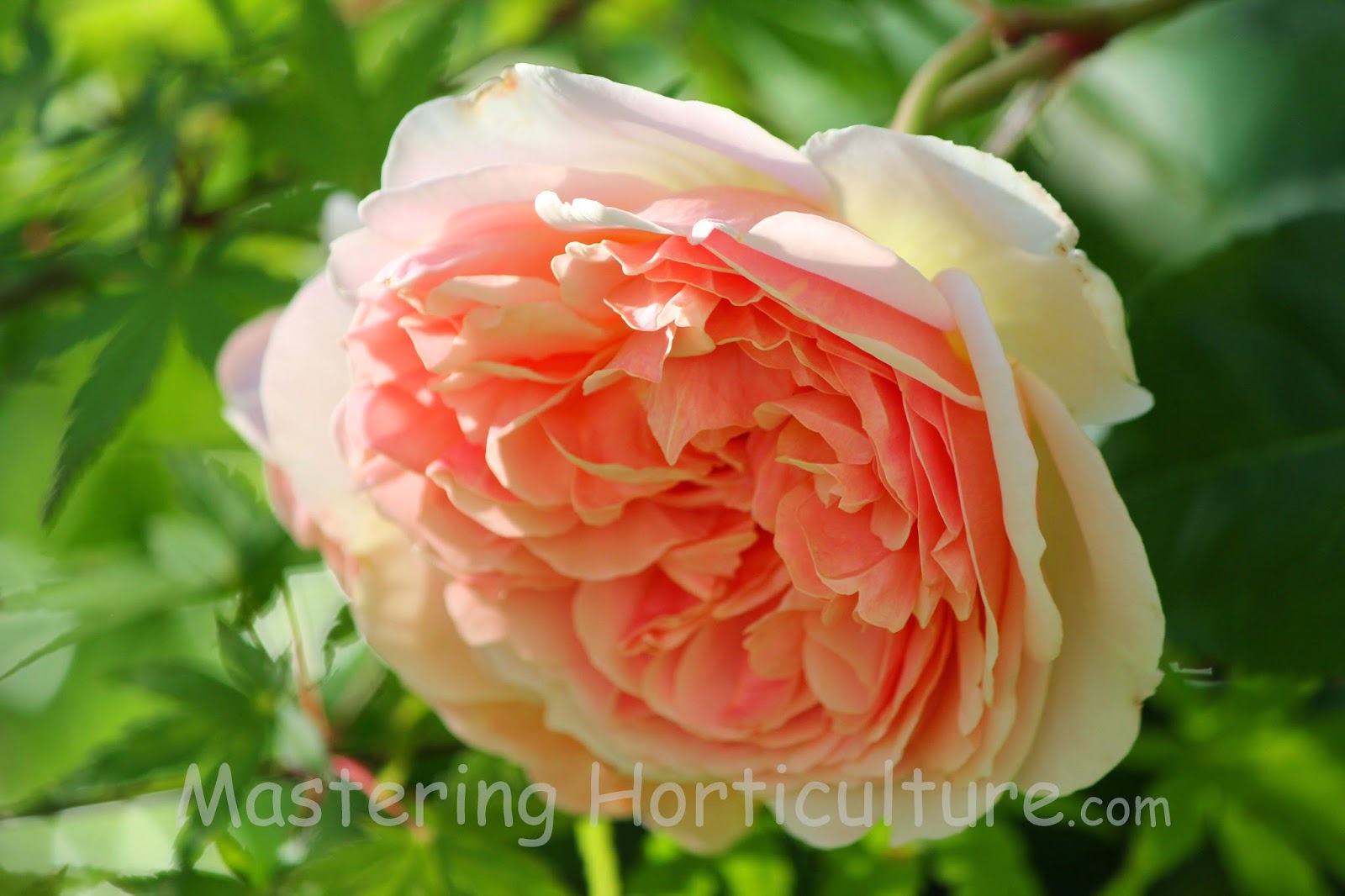
Rosa 'Abraham Darby'  

Roses are beautiful when they are not ugly.  All cultivated roses were selected or bred for appearance and/or in combination with fragrance, disease resistance, vigor and many other desirable characteristics.  They are all beautiful to begin with.  However, we all know that sometimes the promised beauty does not surface due to a number of factors. With more than two decades worth of experience in growing roses in California, I've come to realize a simple truth - there exists no spectrum when it comes to the outcome of the rose. There are only two opposing classifications: beautiful or ugly.

A rose plant growing under optimum conditions and cared for by a conscientious gardener, will come out to be a poetic symbol of beauty, love, fragrance and art.  A rose is a rose when the world is fair. But the world is not always fair.  There are microorganisms lurking everywhere - in the air, in the soil and water - just waiting for the its carrier and opportune moment to charge the garden.    The weather that dictates production rates of plants can be austere or excessive with its blessings and sometimes favors the proliferation of the microscopic society with its ever changing combination of humidity and temperature. All of these natural factors contribute to the outcome of roses.  Then there is the gardeners and his/her management techniques or lack thereof.


Rosa 'Evelyn'

They are beautiful this year.  Their leaves are clean with no significant diseases to worry about at present - hopefully it will stay that way. With the exception of the ones that are shaded by trees, all are growing better than in the previous two years.  The sweet fragrance emanating from the David Austin rose 'Evelyn' is very pleasant that even after many years of purging my rose collection, I thought of checking the rose catalogs again.  :)

Rosa 'America'

Although, the natural factors remain to be out of my control, there were some things that this gardener did that possibly contributed to the excellent performance of the roses during the current season.

1. Deliberate choice and timing of fertilization.  Complete fertilizer (16-16-16) was applied to all my roses right when the new buds were about three inches long and around the time when we had some rain in February.  This is key to the vigor of the roses in the early spring.  A second application was done during the first deadheading.

2.  Limited but regimented watering due to statewide water conservation. Watering is regulated in our area - this time we can only turn on our irrigation systems twice a week.  This means that we are not in danger of over watering the plants and daily exposure to moisture on the leaves.

3.  Increased presence of birds in the garden.  The birds like to linger in the yard with the consistent provision of food and water.  As a result they are also there to peck on bugs before they become a problem.

4.  Improved soil condition through generous application of mulch.  Our pet bunny uses sawdust pellets as bedding material which in turn becomes mulch for the flowers and shrubs.  We all know the benefits of mulch in soil moisture conservation, weed control and soil structure.  And yet, here we have a bunny-enhanced mulch with higher nitrogen content!  Beyond all these perks, the decomposition process of the sawdust reduces the soil pH to some extent.  Since roses prefer a slightly acidic soil, this practice has positive effects on roses.

Rosa 'Sally  Holmes'

Roses are beautiful when they are not ugly.  :)


Tuesday, March 24, 2015

Citrus Care: Gearing up for the Next Crop

Fig. 1    Flower buds and new leaves emerge as the temperature rises.

As the California temperature rises, the once cold-beaten citrus trees are now on a rebound.  New buds are starting to surface from under last-year's foliage - promising another bountiful crop (Fig. 1).  In order to have that promise materialize, there are a few things to keep in mind. 

Factors to Consider All Year

Sunlight.  Citrus plants need long hours of sunlight.  Make sure they get at least six hours of good sunshine everyday.  

Soil Nutrient.  Citrus are heavy feeders.  Apply fertilizer during the early spring.  In my garden, I use 16-16-16 in late winter to replenish what was spent during fruiting and to give them an early starter food for spring.  Repeat fertilization once a month and give them a dose of fertilizer containing micro-nutrients - especially for plants grown in containers.  
  
Soil Moisture.  Contrary to popular belief, citrus plants require moderate amounts of water.  Water them regularly in the early spring to ensure excellent fruiting.  Fruit-set is highly dependent on optimum water during flowering to fruit set.  


Fig. 2  Allow the trees some rest by harvesting the last season's fruits.


Things to Look Out for in Spring

Last season's fruits.   Citrus fruits are beautiful and unlike other fruit trees their fruits do not abscise readily.  If you have not done it already, it is time to harvest the remaining fruits to allow the plants to completely focus their resources into the development of the new crop (Fig. 2).  

Suckers/Water Sprouts.  Water sprouts also known as suckers are a natural occurrence in citrus plants.  They are vigorous young branches growing vertically which often come with thorns (Fig. 3). They are healthy-looking but if allowed to remain, they will exhaust huge quantities of resources such as water and nutrients at the expense of the rest of the plant.  Therefore, cut off water sprouts as soon as possible.

Fig. 3  Water sprouts are vigorous growth with 

Fruit Drop.  Flowering and fruit set directly affects final yield of citrus plants.Under favorable conditions, citrus plants generally set more fruits than they can support and at some point, the tree will naturally shed some of the tiny fruits (usually the size of jelly beans).  Excessive fruit drop could be a result of water stress.  Numerous studies have shown that water stress influences flowering and fruit set.  Make sure the trees get sufficient soil moisture during these critical stages.

Pests.  Snails, slugs, scales, and leafminer can all pose a challenge to citrus plants.  There are a million options when it comes to pest management.  Nonetheless, success can only be achieved by proper timing.  Control snails and slugs in late winter before they can have a chance to lay eggs or damage plants.  Applying horticultural oils can prevent scale infestation.  Spinosad or Pyrethrin can control the leafminer moth before oviposition.  Still, allowing nature to deal with its own seasonal imbalances is even better.  When pests arise, some insects that are antagonistic to them also flourish.


With a little attention to details, your citrus trees will reward you with a bountiful crop.

Thursday, February 26, 2015

My Cymbidium Photo Gallery 2015

This is the time of year when my cymbidiums are in bloom and thus the obligatory orchid photo-shoot.  The variety names of these ones are not known to me but I will let the flowers speak of their kind.  

New this year - I got it as a gift. 

The only green-colored one in my collection - always blooms earlier than the others.

New this year - Bought from the Farmer's Market in Marina, California

New this year - Bought from an ethnic grocery store in Marina, California.

One of my old time favorites - turns pinkish when the temperatures are low.

New this year - bought from Marina, California.

I've had this for a long time.


Cymbidiums are not only beautiful - they also lasting.   
Try growing one this year 

Related Posts with Thumbnails